Emma Willard v. Christopher Yates, the Common Schools, and A Petition to Build a Normal School in Kensington (1838-1843)

“I come now to treat a very delicate and difficult subject–the unfortunate marriage of Mrs. Willard with Dr. Yates. Gladly would I omit this chapter, but, by so doing, this memoir would be partial and incomplete. It is misfortune, not folly, which I am about to describe; and, when viewed in all its relations, reflects no discredit on Mrs. Willard…” -John Lord Life of Emma Willard (1873)

“The common school should not longer be regarded as common, because it is cheap, inferior, and only attended by the poor and those who are indifferent to the education of their children, but common as the light and the air because it’s blessings are open to all and enjoyed by all. That day will come. For me, I mean to enjoy the satisfaction of the labor…” -Henry Barnard

Definitions:

Common School: Public School

Normal School: A school that taught teachers how to teach

School Society: School System or Board of Education

School Visitors: Inspectors

Education was always very important to the Moore family. In the early 1800’s Connecticut towns began forming school societies, and in 1810 Connecticut started a school fund for the societies to help pay for their schools, teachers, textbooks, etc. By 1826, there were 208 school societies, which included Berlin, with 24,851 students statewide between the ages of four and sixteen. By 1829, there were 84,899 students. In 1826, Sheldon Moore’s brother, Oliver was one of three elected committee members on Berlin’s first school society, which was formed in Kensington. In 1829, Sheldon was named Moderator, Oliver was Clerk, and another brother, Eli was hired as a teacher. Later Sheldon would become a school visitor.

However, by 1835 an investigation initiated by Governor Henry Edwards found that Connecticut schoolhouses were poorly furnished, parents had become indifferent, teachers were unskilled (most were woefully underpaid) and attendance was down by more than six thousand. The state’s common schools were in need of an overhaul.

Enter Henry Barnard. Yes, the Henry Barnard. But, he wasn’t yet the Henry Barnard we know today. The future education reformer and the country’s first Secretary of Education was at the time only eight years removed from graduating Yale. He was currently spearheading a project to revive the long dormant Connecticut Historical Society and had founded the Hartford Young Men’s Institute, or as we know it today, the Hartford Public Library. More importantly to this story, in 1837 he had been elected as a Legislator in the Connecticut General Assembly. He was the youngest representative ever elected by Hartford voters at the time.

He also began publishing (sometimes at his own expense) the Connecticut Common School Journal. The periodical was published from 1838-1842 and offered some transparency into what Barnard was trying to accomplish (better and more comfortable schoolhouses, improved teaching methods, etc.). Reports from school societies and school visitors also appeared in every edition. Through Barnard’s unrelenting efforts, a real interest and excitement began to take place around the common schools.

Connecticut Common School Journal (Personal Collection)

Note: In Commentaries on American Law (1844), James Kent called the Connecticut Common School Journal, “a digest of the fullest and most valuable information that is to be obtained on the subject of common schools both in Europe and the United States.”

Barnard believed that women made better teachers and began to eliminate all but the best male teachers. He wrote in the Common School Journal, “Heaven has plainly appointed females as the natural instructors of children…”. Furthermore, he believed women should also be running the schools as principals and superintendents, writing, “Experiments as far as they have gone, encourage the belief that well-educated females may bear a far more extensive and important part in the instruction and government of our common schools…”. What he could really use to prove his theory was an extraordinary female teacher. Preferably one who had experience running a school.

Enter Emma Willard. Yes, the Emma Willard, a native of Berlin (Kensington actually) who, by 1838, had already made a name for herself as an author of textbooks and had cofounded, with her late husband John Willard, the very successful Troy Female Seminary school in Troy, New York. She had also amassed quite a bit of money. On September 17th of that year, the widow Mrs. Willard married Dr. Christopher C. Yates of Albany, New York (also widowed, and like her first husband, older than herself). The ceremony and reception were held at Emma Willard’s beloved school, surrounded by one hundred and fifty of “her girls”, who were all dressed in white and held white flowers. Following the celebration, the couple honeymooned at Niagara Falls. Emma had recently relinquished control of the seminary to her son, John and his wife, Lucretia, who became superintendent and principal respectively. Dr. and Mrs. Yates were now ready to begin their new life in Boston, where Emma had rented a house.
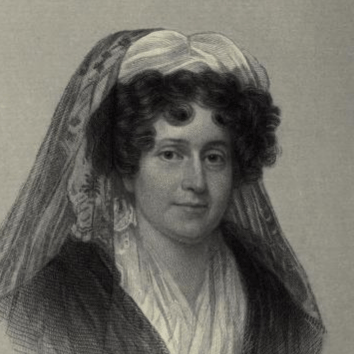
But only nine months later, the couple was separated. Emma had walked out on her husband. The decision to so was not be taken lightly by a woman in the 19th century. A wife who abandoned her husband risked losing everything and could become a social pariah. However, Emma’s marriage to Dr. Yates had become so intolerable that she felt she had no other choice. In a letter to a close friend, she later explained why she left and described Yates as a man who was far different from the man she had married:

“Words cannot tell of the agonies I have endured. He found my fame and my own opinion of possessing talent above the common mind inconvenient to him, and he set himself systematically to work to bend and break my spirit. This was not the worst. His shocking irreligion, manifested at times when he acted as a priest in the family, to lead in such devotional services as we kept till the day I left him, gave me more anguish than anything else, and were a nature to justify me, before God and man, in refusing to live with him.”

Besides his feeling threatened by her intellect and mocking her religion, there was a whole money issue. Despite a marriage contract, that she had drawn up before their marriage to protect her assets, which were considerably more than his, he had found ways to access her accounts (possibly by forging her name or that of her son, as he was later accused) so that he, and his children could live lavishly. This began the night of the wedding, when he was given the bill for the reception dinner and he subsequently handed it to her. Later, when they moved into their house (that she rented), he spent $5000 of her money to furnish it. When he informed her that he wanted her to buy a mansion, she finally put her foot down and told him no, and it was then that he set out to break her.

In June 1839, Emma and Dr. Yates left Boston together. He was going to visit his children in Nova Scotia, and she was going to Troy. They went as far as Providence, Rhode Island and parted ways. She didn’t tell him she was leaving him because she was still unsure that she was going to, and he was unaware that she was unhappy.

Once in Troy she decided that she could no longer live with this insufferable tyrant, and with her son, she drafted a letter that she sent to Yates for him to sign, that she hoped would dissolve the marriage. He didn’t sign it. Instead, the jilted husband made a copy of it that he later shared with the Boston Globe. Throughout 1839 their separation would be played out in the newspapers around the country, with the papers first leaning towards Willard and later towards Yates.

Excerpt from The Philadelphia Inquirer October 30, 1839

An article that appeared in the Hartford Patriot in August, and was widely circulated, gave Mrs. Willard’s account of the matter and called Yates a “tyrannical and unprincipled man, and withal an open infidel and debauchee”. It went on to say that the doctor had refused to let Emma remove her furniture or her carriage from their home and she had hired a lawyer (her brother-in-law, John Phelps) to retrieve her property.

Upon his return from Nova Scotia, Yates angrily wrote to the Boston Globe concerning the “libelous attack” upon him in the Patriot and the New York Sun and promised he would be visiting Hartford and New York to demand his “due acknowledgements” from the publishers of both newspapers. Yates also defended himself, stating he had never taken money from Emma Willard, and the reason for her departure was that she had asked him to lend his name to a seminary school that she intended to open in Boston, but he had refused because he was planning on them moving to Albany, so that he could resume his practice. The threat of libel had the result he had intended and many of the papers that had run the Patriot article, now ran the Globe article. The Philadelphia Inquirer wrote, “How long has Mrs. Willard been a disciple of (feminist) Fanny Wright? Or in what school can she have learned that differences of opinion justify a wife in abandoning (her husband)”?

Besides the bad press, which is something Emma Willard not have been used to, upon her arrival in Troy she had asked for control of her school back, and the Board of Directors had denied her request. They were quite satisfied with the work that John and Lucretia Willard were doing. With that, she decided to return home. To Connecticut that is, and her hometown of Berlin. In her native state her reputation was still beyond reproach, and it was there that she filed for a divorce. However, divorce cases were heard before the state legislature, which met annually in Hartford for a few weeks in May. It might take years before her case came up. She moved in with her sister, Mrs. Mary Lee, in Kensington and prepared for a long wait.

In the winter of 1839, Henry Barnard visited Kensington to lecture before the school society. Mr. Barnard and Mrs. Willard were familiar with one another, having been introduced years earlier by a mutual friend, Dr. Eli Todd. It was at this time that Barnard asked Emma if she would write a proposal on how to improve the common schools in the town. Wishing to be useful and keep herself busy, she agreed.

On Wednesday, March 18, 1840, a “great meeting” about the common schools was held in Kensington at the Congregational Church. Even though it was held in the evening and the snow on the ground was very deep, the meeting house quickly filled up with not just the residents of Berlin, but many of the surrounding towns as well. The Reverend Royal Robbins quipped that in his 22 years as pastor he had never seen the church so full. Robbins was in attendance, not just because it was his church, but also because he was a school visitor in the society. The children from the parish’s four schools, who had been standing in line on the steps outside the front doors under the banners while a hymn, written for the occasion by the good reverend, were then lead in and addressed by Jesse Olney of Southington. Music was played by a band from the Worthington parish, and then Emma Willard’s address and proposal were read aloud by Elihu Burritt (the “Learned Blacksmith” as he was known) of New Britain. Please remember that in the 19th century it was still not proper for a woman to speak publicly. The crowd listened to her words, “with deep and thrilling interest.” Then refreshments were served, and the children were led out as they had come in. The night had been a huge success.
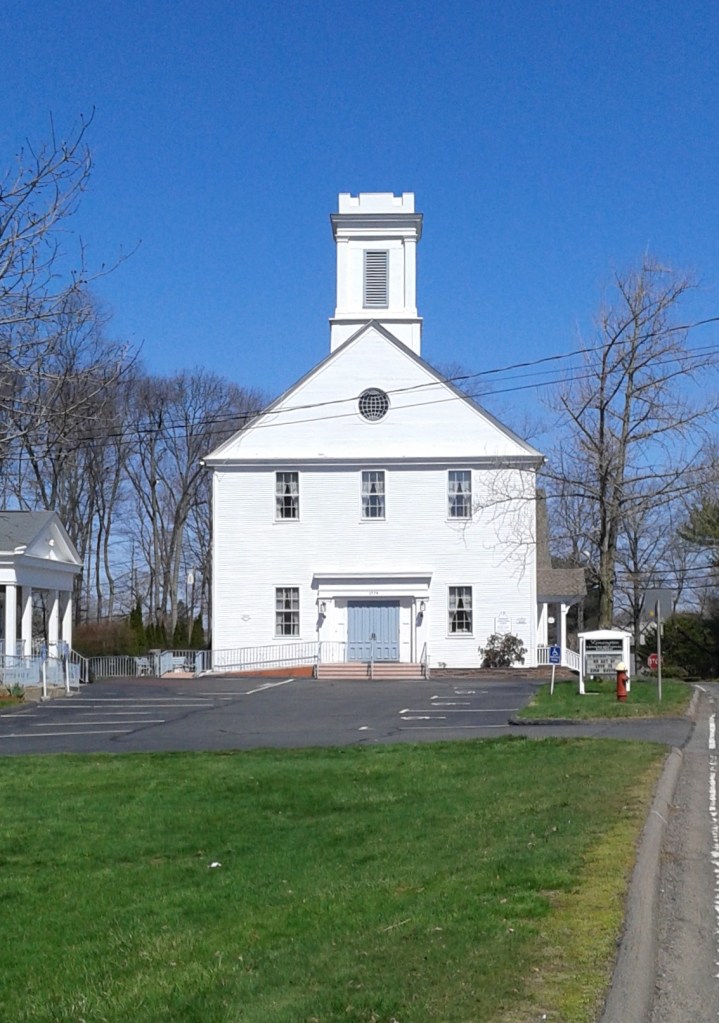
Kensington Congregational Church (2016)

Emma Willard’s proposal caused a great deal of excitement among the people of Kensington. The school society was very impressed and immediately asked her to be superintendent of the schools for the upcoming summer session. Although she considered the position beneath her, she agreed, but only if she could get the full cooperation of the parents of Kensington. She did.

She wrote to Henry Barnard on May 17th to say she had accepted the position and to outline the upcoming changes to the schools. As he wished, all four of the school’s teachers would be female. The one large classroom in each of the schools would be subdivided into separate rooms and children would be taught in classrooms with children of their own age. Older girls who excelled in their studies would be asked to be teacher’s assistants, who would be trained to become teachers. This being the only way to train teachers given her resources, and in fact, the way Mrs. Willard herself had been trained in 1804 at a school in Berlin (Worthington to be precise). She had also tested this method, with great success, in Troy.

Upon examination of the school’s libraries, she found they contained too much fiction, which she believed was detrimental to the children’s minds, because young scholars may not be able to distinguish the difference between fact and fiction. Therefore, she recommended removing most of the fiction from the schools.

Among her other proposals was this:

“Each schoolhouse should, we think, be provided with a clock; no matter how plain, if it do but perform its office correctly. Whatever is to be done regularly requires a set time as well as fixed place, and teachers on low wages cannot afford to buy watches…”

(Did Emma Willard invent the school clock?)

As superintendent she drilled her teachers constantly. Even requiring them to come in on Saturdays for further instruction and testing while the children were away. She interacted with the students, sometimes teaching them herself. She composed and taught them a song called Good Old Kensington, that they sang together everyday. Music was part of an expanded curriculum that well beyond “reading, writing and ‘rithmetic”, and now included geography, history and scripture. Girls were taught the “use of needle and thread”, which they would need in their “feminine employment” (Mrs. Willard, though she believed girls and boys should be taught equally, realized that most girls would go on to become wives and mothers, and should be taught the necessary skills in school. At the Troy Seminary, she has been credited with first introducing Home Economics).

In a report to Henry Barnard published in the November 1840 edition of the Common School Journal, the visitors, that included Sheldon Moore and Royal Robbins, had nothing but praise for Willard’s improvements, and noted, “It is believed that the public opinion has been decidedly favorable, and that the parish has acquired a reputation abroad which it should be anxious to sustain.”

Also that fall, Mrs. Willard organized the Female Association to Improve Schools in Kensington’s east district school (Sallie Caliandri of the Berlin Historical Society, believes this may have been Ledge school, and the other three were possibly West Lane, Stockings Corner and Blue Hills). Every mother in the district, with children in school, and two single women joined the association. This was one of two schoolhouses that had been remodeled per Willard’s proposal, and one of the association’s objectives was to improve the appearance and overall comfort of the school.

However, by the time the association began meeting Emma had been called away to Hartford by Henry Barnard for a new project, the formation of a State Normal School. Barnard wrote in the Journal in January 1841, “The great and pressing want, that in comparison with which most of the others sinks into insignificance, is the want of well qualified teachers…It is apparent then, that the normal schools are imperiously called for by the wants of the common schools as they now exist, and are still more essential in view of the great improvements which the system is destined to receive.” Normal schools had existed in the United States since 1823, when the first was built in Concord, New Hampshire. The first State Normal School had just recently opened in 1839 in Lexington, Massachusetts, through the efforts of Horace Mann, another education reformer and personal friend of Barnard. If Barnard could get the legislature to approve his proposal, Connecticut would have the second state-run normal school in the country.

His plan was to have Emma run the school, and one of the first questions, the reason she had been called to Hartford and put on a committee, was where in the state would the school be located? The decision would ultimately be hers.

The first and possibly most obvious choice was Hartford. In fact, there was a large brick building available in the southwest part of the city, near Washington College (Trinity College today), that Emma believed would be perfect. A small portion of the building was an orphanage, and the children would be in her care. The orphans would then be taught by the teachers in training from the normal school without, as she wrote, “a set of unreasonable parents to break up our plans”. By early February 1841, she seemed convinced that the school should be there. But, there had been a second choice. Kensington.
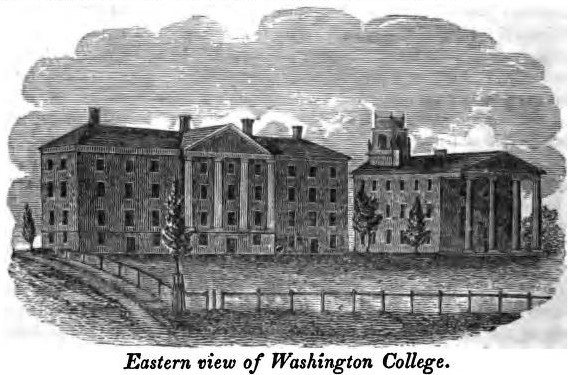
Connecticut Historical Collections John Warner Barber (1836)

Yes, Kensington! Just when she thought she had made up her mind she received a petition from Kensington which was signed by nearly all the citizens of the parish. The children even sent her letters asking her to come live among them. Sheldon Moore also wrote her; however, he had been ill that winter and his letter to Emma had been delayed until he felt better. On February 20th, she wrote him from Hartford to say that though a final decision hadn’t been made, she wished she had heard from him earlier, and if she had, she would have already chosen Kensington. She was pleased to hear of the “good spirit” that “exists in Kensington” and told him, “You are certainly right in supposing that other things being equal, I would rather be the means of benefitting my native place than any other.” Emma was now clearly conflicted and wrote her daughter-in-law on March 2nd and said, “I cannot help thinking that I should be happier there (Kensington) than in Hartford.

But where to locate a normal school would be a moot point if the state legislature didn’t approve Barnard’s proposal, and that decision, like Emma’s divorce. was going to have to wait.

Meanwhile Mrs. Willard’s common school improvements and her Female Association were both successful. In May 1842, Reverend Robbins reported on his visit to the east district school, which was later published in the Common School Journal. He wrote that trees had been planted for shade and bushes and flowers now adorned the outside of the school. Inside, there were new, more comfortable desks and chairs, a place for the children’s hats, bonnets and coats, a globe, maps and a model of the solar system. There was also a clock, but it wasn’t working (seriously?). Robbins reported that the association met once a month at the school and if school was in session, then the children would be invited to attend the meetings. He noted that, “The effects of these meetings on the school is visible”. In fact, in over twenty years as a school visitor, he had never seen children more willing and ready to attend school and eager to learn, and he hoped that the results he witnessed would carry on for generations to come.

However that same year, the normal school project suffered a blow when a new governor and legislature were elected and the Board of Commissioners for Common Schools was subsequently abolished. Now disenchanted with politics, Henry Barnard didn’t seek another term as the Whig representative for Hartford. He would never again run for office and instead turned all his efforts to the betterment of education in the United States, and would soon leave Connecticut for Rhode Island to improve the common schools in that state.

Finally, in May of 1843, the state legislature heard a Petition of Benjamin Allyn and others for a Normal School in Berlin. Mr. Allyn, Esq. was a Kensington resident and a nearby neighbor of Sheldon Moore. After the petition was read, it was referred to the Committee on Education where, without Henry Barnard’s support, it died a natural death.

But, there was good news later that month when the legislature granted Mrs. Emma Yates a divorce, and as she had requested, allowed her to go back to her first married name, Emma Willard. This being the name she preferred, and the name she had been using since her separation from Yates.

Her exile in Kensington now over, Emma contemplated moving to Philadelphia, where she had been asked to help improve their common schools. She also toyed with the idea of publishing her own common school journal in that city. This time however, her son and daughter-in-law intervened and convinced her to return to Troy, where they felt she belonged.

It took six years, but in 1849, the legislature finally passed an act to establish a State Normal School. The school would not be built in Hartford or Kensington. Instead, it was established in New Britain on May 15, 1850. The following year, a new building, that would become the new school, was dedicated in that city, on Main Street where it intersects with Walnut and Arch Streets (the building is now gone). In attendance that day was Henry Barnard, who was back from Rhode Island and was once again Superintendent of the Common Schools in Connecticut and had been named principal of the normal school. The school still ended up being the second state-run normal school in the country.
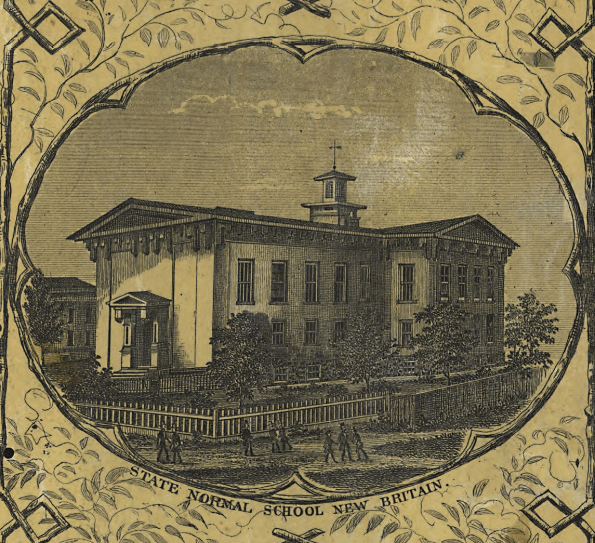
Circa 1855
Circa 1900

In 1883, the normal school moved into a larger, grander building. It was moved once again in 1924 and renamed the Teacher’s College of Connecticut. Today it is Central Connecticut State University (CCSU. Go Blue Devils!) If one were to visit the impressive campus, they would find Henry Barnard Hall, the Elihu Burritt Library and the Emma Hart Willard Hall and parking garage.
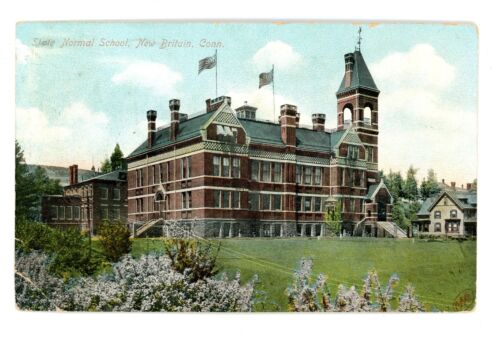
Postcard circa 1905. (Personal Collection)

As for Dr. Christopher C. Yates, he died in Nova Scotia on September 23, 1848. Though Emma Willard’s divorce from Yates never really tarnished her legacy, his reputation may have always been questionable. In a biographical sketch that appeared in the Annals of the Medical Society of the County of Albany after his death, Dr. Yates’ many accomplishments are listed, but the sketch ends with this comment about his personality:

“…in his character and example, there was nothing to admire, but everything to avoid; and that his influence upon his profession, and upon society, was demoralizing.”

Sources:

The Life of Emma Willard by John Lord (1873)

Emma Willard, Pioneer Educator of American Women by Alma Lutz (1964)

Life of Henry Barnard, The First United States Commissioner of Education by Bernard C. Steiner (1919)

A History of Connecticut by George L. Clark (1914)

Connecticut Common School Journal (1838-1842)

The Connecticut Quarterly an Illustrated Magazine, Vol. IV by George C. Atwell (1898). Picture of Henry Barnard

The Connecticut Magazine an Illustrated Monthly, Vol. VI by George C. Atwell (1900). Picture of normal school, circa 1900 and Elihu Burritt

Smith’s Map of Hartford County, Connecticut H. & C.T. Smith (1855). Location of normal school and picture, circa 1855

Emma Willard letter, 1841, February 20 David M. Rubenstein Rare Book & Manuscript Library (call number Sec. A 173). Letter can viewed online at Duke University digital collections website:

https://repository.duke.edu/dc/1efe1fc6-2bb2-4d72-9624-4452172328e0?f%5Bcommon_model_name_ssi%5D%5B%5D=Item

Old Sturbridge Village Research Library, Oliver Moore Collection (items 1974.1.1.2.6 and 1974.1.1.2.11, Berlin, CT school society minutes)

Numerous newspaper articles available on newspapers.com

I would like to thank the Berlin Historical Society for their support. https://www.facebook.com/berlincthistorical/
Percival’s Suicide Attempt

The following story recently appeared in The Tin Horn, the newsletter for the Berlin Historical Society. I have been a proud member of the Historical Society since 2015. About a year ago I read in the newsletter that they were looking for stories about the town. Now clearly they meant stories from people who grew up there or folks who have lived there a long time who could share tales of how the town used to be. I can’t claim to be either, since I didn’t grow up there, nor have I ever lived there. But, I’d been sitting on this story I had written about one of Berlin’s biggest celebrities, the poet James Gates Percival. So I submitted the story, which is quite long for a newsletter, and to my surprise they replied that they would include it in four parts this year (Winter, Spring, Summer and Autumn, 2018). I am truly honored that the story appeared in their newsletter and now take the liberty of posting it here in it’s entirety, with a few edits and a footnote.

-spellmanjr 28 Nov 2018

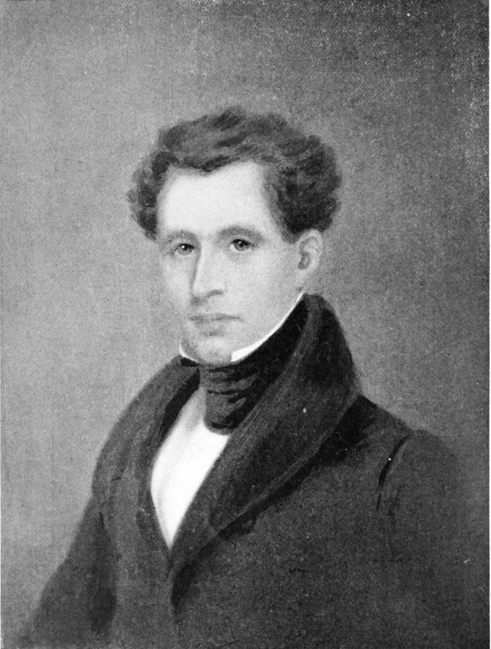
James G Percival
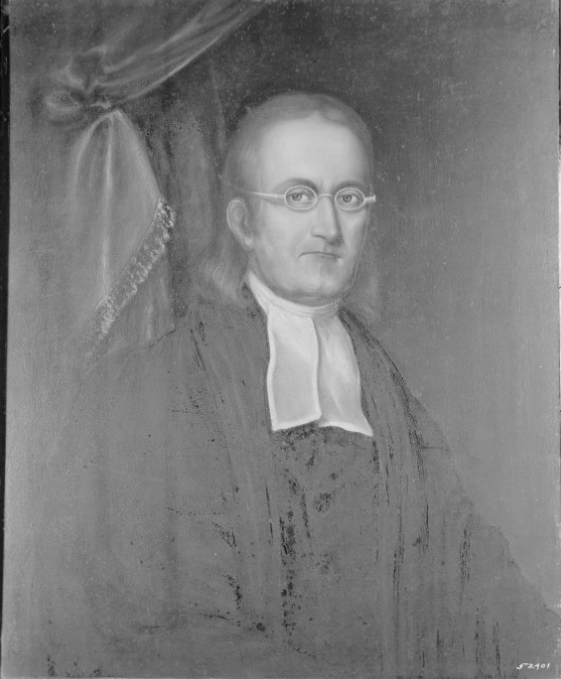
Photograph of a portrait of James G. Percival painted by Edwin Percival

I’ll live no more, I know the world too well. I’ll trust no longer to it’s soothing voice. Let those who choose, in pain and sorrow dwell. Death is my fondest, death is my only choice.

-James Gates Percival “The Suicide”

The poet James Gates Percival’s home is located in Kensington on the street that bears his family’s name, just southwest of the Kensington Congregational Church. It’s not the house he was born in but the home he grew up in, his father, Dr. James Percival having built it in 1789 when Percival was about 3 years old. It’s also where the poet finished his first book of poems, which was published in New Haven in 1821. The house and the village of Kensington were also the setting of Percival’s alleged suicide attempt in the summer of 1820. The poem, The Suicide, which he started writing in 1816 and completed in 1820, appears in Percival’s first book.

Besides being a poet, James G. Percival was a geologist, botanist, linguist and Medical Doctor. But though he excelled at many different things, living in the real world doesn’t seem to have been one of them. He suffered from depression, as did his mother, Elizabeth (Hart) Percival. He was painfully shy and lived in a self-imposed isolation for most of his adult life. This solitude and the comfort he found in it can be felt in his poetry.

Percival House
Percival House, Kensington, Connecticut. May, 2016.

The artist Nelson Augustus Moore, who knew the Percival family personally, once wrote of James and his brothers, Edwin and Oswin, “all three never seemed to belong to this world, extremely sensitive in their natures, of an organization of the finest nerves, they could not bear the rough contact of the world”.

The author Samuel G. Goodrich (aka Peter Parley), whose family lived in Berlin and was a friend of Percival’s, also wrote of him, “His mother was by nature of a susceptible and delicate organization, and she seems to have imparted to her son these qualities, with a tendency to excessive mental development.”

Percival’s life was altered dramatically when he was 11 years old with the death of his father and his sister, Harriet, who died within a month of each other. The elder Dr. Percival was a very successful local physician, businessman and land owner, and he left a considerable amount of property to his three minor sons.

James and his brother, Edwin were sent to Hempstead, Long Island to live with their maternal uncle, Reverend Seth Hart. Described as an, “amiable man of a cheerful an almost jovial temperament”, Reverend Hart’s personality was in sharp contrast to his melancholy nephew. Uncle Seth tried to get young James to break out of his shell and Percival hated him for it. Portions of “The Suicide” were directed towards his uncle, including the verse:

Ye who abused, neglected, rent, and stained that heart, when pure and tender, come and dwell. On these dark ruins, and, by Heaven arraigned, feel, as you look, the scorpion stings of hell.

sethhart
Portrait of Reverend Seth Hart. Also painted by Edwin Percival.

When he was 16 years old Percival entered Yale College, using some of his inheritance to pay his tuition. As he usually did, he excelled in his studies but struggled socially. He graduated in 1815 second in his class. He would have been first but didn’t wish to be Valedictorian because he wasn’t a good speaker. He was unable to choose a career and took a couple of jobs as a tutor. His mother was now married to Samuel Porter, a local farmer, and James worked on his stepfather’s farm. Unfulfilled, he reentered Yale, this time to follow in the footstep’s of his father and become a physician.

It was around this time that he fell in love with Mary Ann Goodrich, the sister of the aforementioned Samuel Goodrich and Charles A. Goodrich, also an author and the Worthington Parish pastor. James and Mary spent time walking together and reading poetry. But when he admitted his love to her, she announced that she had been promised to another. Mary married Nathaniel B. Smith in 1819.

Still another love was a young woman that he tutored while living in Philadelphia. One day during their studies her hand accidentally touched his. Without saying a word, he not only left her home, but also the city and returned to New Haven. He later wrote her admitting his feelings. She had a family member respond for her that she was not interested. After these two rejections Percival is said to have given up on love forever.

The Life and Letters of James G. Percival was written by Julius H. Ward and published in 1866, ten years after Percival’s death. In recounting Percival’s early days Ward, who had never met the poet, relied on Percival’s family and friends, such as his brother, Oswin, Reverend Royal Robbins and his lifelong friend and neighbor Sheldon Moore to tell his story. It’s important to mention that these men were older by this time and were being asked to remember events that had happened forty or fifty years earlier. It seems that some of the details of these events may have been confused or embellished by the storytellers, or may have been just made up by Ward.

For instance, after graduating from Yale again, this time with a Medical Doctorate, Percival returned to Kensington and began practicing medicine. Ward claims that soon after, Dr. Percival was called to a local family’s home to tend for their children, seven in all, who had contracted a malignant fever that had been ravaging the region. He was unable to check the disease and five of the family’s sons, ages 2 to 12, all died within days of each other. Percival was now unable to bear the responsibility of being a doctor and gave up his practice. But there doesn’t seem to be any record of a family in Berlin, or even the State, losing five children at that time.

Even more questionable are the details of Percival’s suicide attempt in 1820. Ward wrote that Reverend Robbins was walking with Percival when he suddenly began running across a field and ran head first into a wall. Oswin Percival told Ward that James had tried to overdose on Opium. Others had seen him hitting his head on trees or trying to crush his own skull with a large cobblestone. Percival had supposedly considered going to the shore and drowning himself. Finally he decided to go to Middletown and get a gun to shoot himself in the head. He began making his way there when, as Ward writes, “all at once the disease left him; the pressure at his head was gone…and turning about, he went home a sane man”. So, the question is, is this story believable or is it just a tall tale?

Luckily, a firsthand account does exist and is contained in a letter from Oliver Moore to his brother, Sheldon, at that time teaching in Sharon, Connecticut. In the letter, dated July 14, 1820, Oliver wrote that Percival had for some time been telling anyone that would listen, that he just couldn’t live in this world and planned on killing himself. Oliver went on to say, that Percival had decided a week earlier that he would commit suicide after his mother visited him, but that day had come and gone and Oliver hadn’t heard anything else about it.

There were several theories going around Kensington as to why this highly educated man would want to end his own life. Oliver Moore believed that Percival had studied too hard. One Jabez Cowles thought that he hadn’t matured into a man and now was unprepared to function in society. Others believed that Percival, who had spent the remainder of his inheritance to go back to school, just couldn’t bear the thought of being poor. And a few thought that this was a ploy to scare Oswin into giving him some of his property. Ward wrote that the rejections in love and the failure of his medical practice had lead to his decision to commit suicide.

In his memoirs, Recollections of a Lifetime, Samuel Goodrich wrote that Percival had only contemplated suicide during this period of his life, but that his mother (Goodrich’s) had talked him out of it.

It’s unknown if he ever contemplated suicide again. But Edwin Percival is believed to have starved himself to death in Troy, New York in 1848.

James lived out his life as a bachelor, as did both his brothers. Sheldon Moore would later say that he viewed him as a “sinless being”.

Though he made money in his many endeavors he never had any, and he lived in near poverty until his death. After spending a small fortune on his education he later spent another small fortune on his vast personal library, which was comprised of about seven thousand volumes when his executors sold it off in 1860. Oswin was also not good at handling money, and his cousin, Benjamin Hart was forced to declare him incompetent and take over his finances.

Percival himself remains silent on an actual suicide attempt. In the preface of his first book of poems he wrote, “Perhaps some apology may be demanded for ‘The Suicide’. I can only say, it is intended as a picture of the horror and wretchedness of a youth ruined by early perversion, and the causes of that perversion. It is not without moral to those who can see it. I wish to impress on the minds of all who read it, the great dangers of indulging the evil propensities, or tampering with the feelings of children. This is a truth, which I have felt in the deepest recesses of thought and feeling, and I would, if possible, lift my voice against the noxious arts, which are daily polluting the stream of life, and sinking Man lower and lower in degradation”.

Footnote: On January 4, 1907, Sheldon Moore’s son, John committed suicide in Pittsburg, Kansas, where he was visiting his daughter, Anna Lemon. He shot himself in the head about a block away from his daughter’s home in front of many witnesses and died an hour later. He was said to have been depressed about his failing health. He was 74 years old.

Sources:

The Life and Letters of James Gates Percival by Julius H. Ward (1866)

James Gates Percival: An Anecdotal Sketch and Bibliography by Henry Eduard Legler (1901)

The Poetical Works of James Gates Percival with Biographical Sketch by James Gates Percival. Biographical Sketch by Erasmus D. North M.D. (1859)

Recollections of a Lifetime or Men and Things I Have Seen, Vol. 2 by Samuel G. Goodrich (1856)

Autobiography of Nelson Augustus Moore (Unpublished)

Sheldon Moore Papers Yale University Manuscript MS 992 (Letter from Oliver Moore to Sheldon Moore)

Art and Artists in Connecticut by Harry Willard French (1879) (Edwin Percival Sketch)

Wisconsin Wills and Probate Records, 1800-1987 (James G. Percival Will; Benjamin Hart letter concerning Oswin Percival)

The Records of Convocation, A.D. 1790- A.D. 1848 by Episcopal Church, Diocese of Connecticut (Seth Hart Sketch)

Ottawa Daily Republic (Ottawa, Kansas) 5 Jan 1907 (Obituary for John Moore)

ancestry.com

Picture Credits:

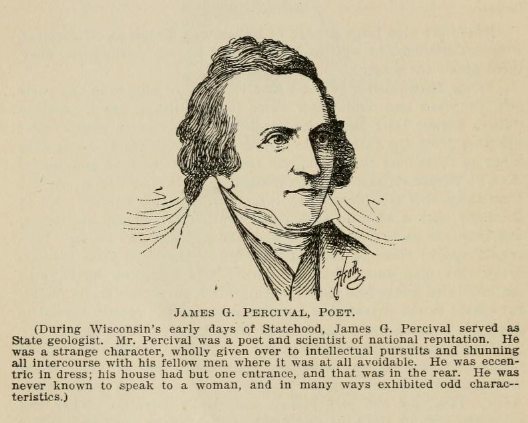
“James Gates Percival. From a Painting by a Brother of the Poet” from The Connecticut Magazine, Feb. 1900, Vol. VI, No. 2

“Portrait of Seth Hart Painted by his Nephew, Edwin Percival Brother of the Poet, James Gates Percival” Image courtesy of Frick Art Reference Library Photoarchive

For information on the Berlin Historical Society visit their website at http://berlincthistorical.org/ or find them on Facebook. 

 

Putting Berlin on the Map

J G Percival
“Leading Events in Wisconsin History” by Henry Eduard Legler (1897).

Kensington, Conn Jan 9th 1856.

Dear Sir,

     As I have nearly completed my map of Berlin so far as I am able without the assistance of some one better acquainted with the physical features of the town than I am & as life is short & art is long, it would gratify me much if you could give me a sketch of them, especially of the streams, if only the work of 2 or 3 hours, & if you could do so, I would forward you a reduced copy of the principal points of roads & the boundaries of the Town if you desired, as I have spent much time on it since the completion of the County Map, which Messrs. Smith allow me to use freely, & it is my intention to complete it in my leisure of the present winter & spring & I should be glad of the benefit of your accurate knowledge & be happy to acknowledge it in a suitable way on the map whether published or not. I am putting on the School District lines & mean to make it worthy of the Town it represents. Please reply to this at your earliest convenience and oblige. 

Yours very respectfully,

S. Moore

This letter was written to James G. Percival from his childhood friend, Sheldon Moore. The letter was written in January, 1856 when Percival was the State Geologist  in Wisconsin. Since 1854, Percival had been living at the home of Dr. John L. Jenckes in Hazel Green. Unbeknownst to Sheldon Moore, Dr. Jenckes had also been caring for Percival since December, 1855 when he became ill after doing some surveying in his new State. Jenckes later said that he believed Percival had been suffering from Chronic Dyspepsia. The illness, whatever it may have been, turned out to be fatal and Percival died on May 2, 1856 at Jenckes’ home.

Sheldon Moore had been doing some surveying of his own in his new role as a County Surveyor. When this letter was written, Sheldon was trying to finish a map of his hometown of Berlin. He hoped to get the map published even though a map of Hartford County had just been published in 1855 by H. and C. T. Smith. Sheldon’s map was to be different from the Smiths’ Map because it included School Districts that the 1855 map did not.

Who better to ask for help from on this project than Connecticut’s former State Geologist and Kensington native, James Gates Percival? Percival, who was said to have walked every square mile of Connecticut, and had certainly had walked every inch of Berlin. No doubt he could recall every feature of the town, even from across the country. Percival’s earlier map of Connecticut, which was part of his geology report, is stunning in it’s accuracy and detail.

Percival in the Woods
“Recollections of a Lifetime” by Samuel G. Goodrich (1856).

Despite being too sick to finish his geology report for Wisconsin, Percival apparently did manage to help out his old friend. Sheldon Moore’s Map of Berlin with School Districts was completed in 1857 and appropriate credit was given to James G. Percival. The map, however was never published.

Connecticut Magazine
Excerpt from “The Connecticut Magazine” Vol. 6 Sep.-Oct. (1900)

Sources:

James Gates Percival Collection. Yale Collection of American Literature. Beinecke Rare Book and Manuscript Library. (YCAL MSS, Box 12, Folder 348, S. Moore 1856).  (Letter transcribed from a PDF copy of the original by spellmanjr).

The Life and Letters of James Gates Percival by Julius H. Ward (1866).

The Moore Family Bible

Bible
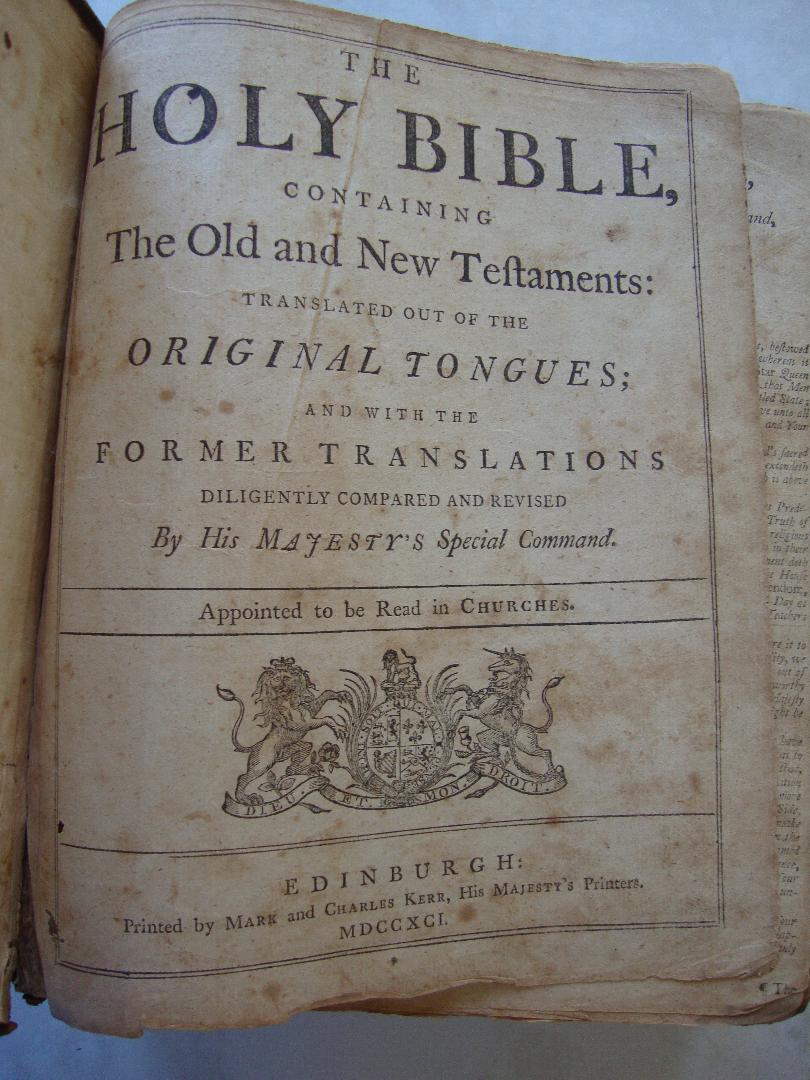
Roswell Moore II Family Bible (1791).

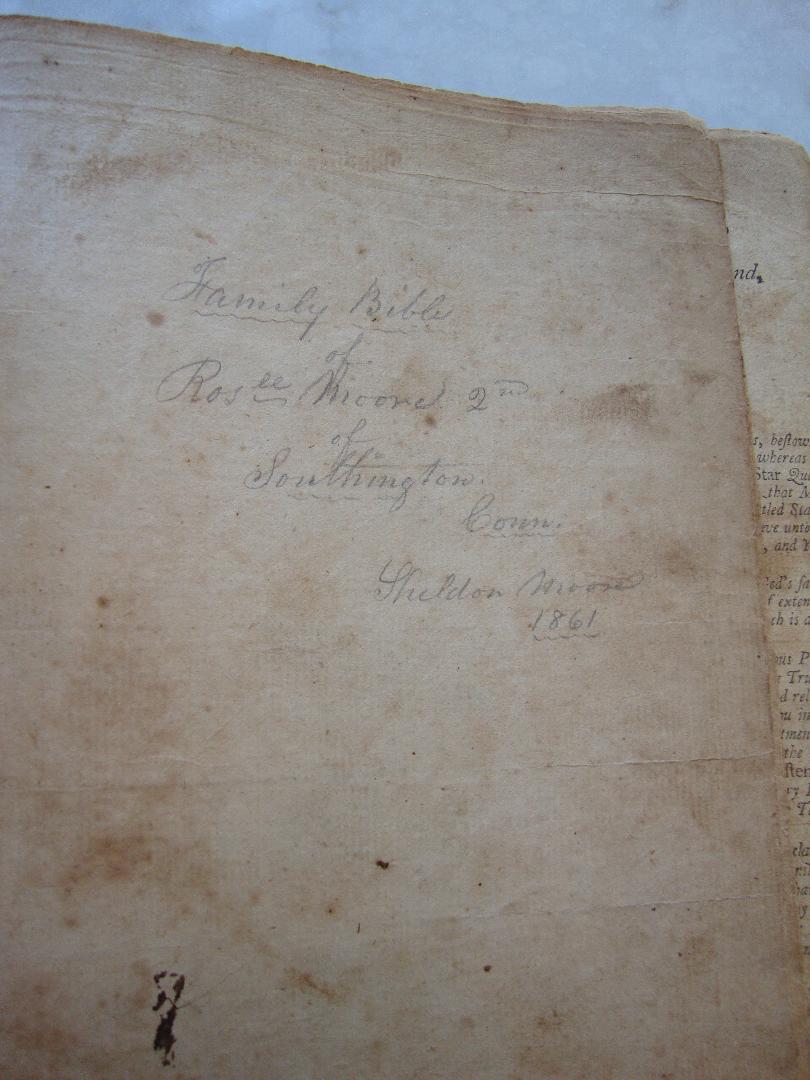
Recently I was contacted on ancestry.com by my third cousin, I’ll call her “Eliza”, about a Family Bible that had belonged to Sheldon Moore’s father, Roswell Moore II (1761-1847) or “Squire Moore” as he was sometimes known. Eliza wanted to know if I would be interested in seeing pictures of the bible which included an inscription by Sheldon Moore. I couldn’t have replied, “Yes!” any faster.

Eliza explained that the bible had been handed down to her by her father, who apparently had got it from his mother, who was a Moore. Eliza’s grandmother must have gotten it from her father, who got it from his father, who was Sheldon Moore’s son, Charles Moore of Southington, Connecticut, who is me and Eliza’s mutual great-great grandfather.

Inscription
Inscription in the Family Bible.

The bible is from 1791, and assuming that Roswell Moore had bought it that same year, then he would have been 30 years old, married for 4 years and had two children, John and Dimmis. The inscription reads, “Family Bible of Ros’ll Moore 2nd of Southington, Conn. Sheldon Moore 1861”.

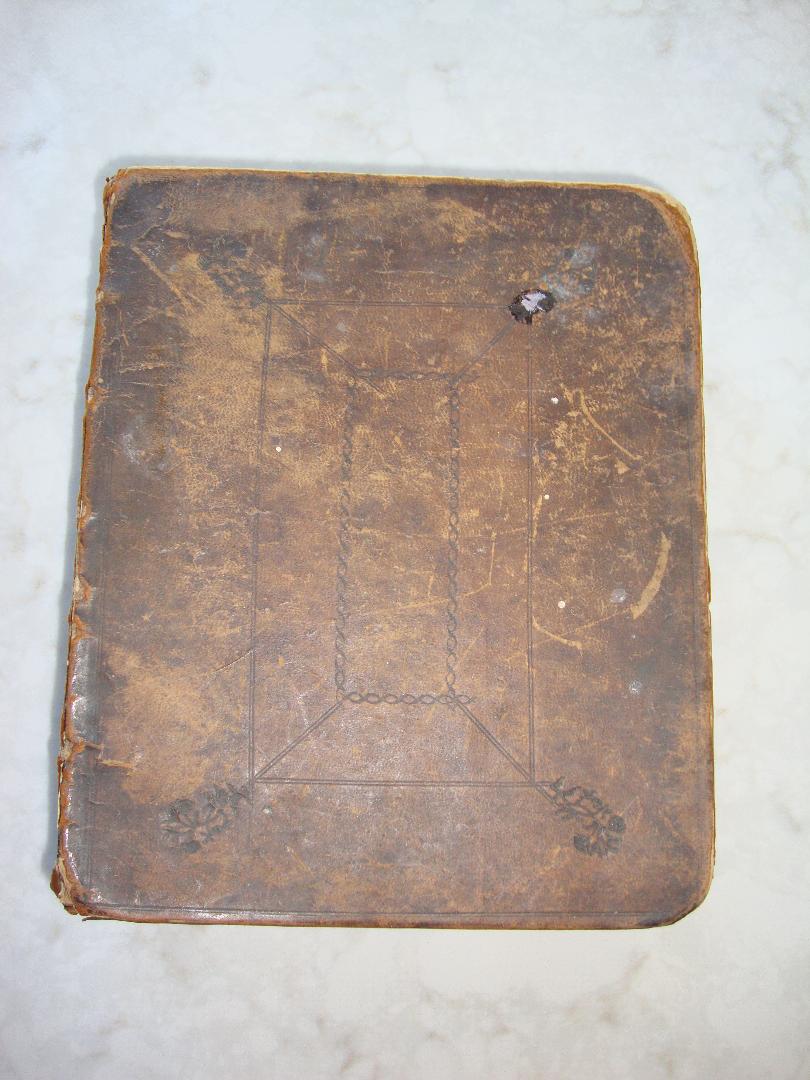
Eliza tells me the bible is in bad shape. The back cover has fallen off and if it ever contained any precious family information, then those pages are missing.

This is not the Family Bible of Roswell Moore that is mentioned in Ethelbert Allen Moore’s book, Tenth Generation. E. A. Moore was the grandson of Sheldon’s brother, Roswell Moore, Jr (1793-1857). That bible belonged to the first Roswell Moore (1728-1794) and did contain family information, as recorded by Sheldon Moore in 1810. I don’t know if that bible is still in existence. But if it is, my guess would be that one of the descendants of Roswell, Jr. has it. They seem to have all the good stuff.

Still, Eliza’s bible is a priceless, family heirloom and I’m thankful that she shared the pictures with me.

bible1
Back Cover of the Bible


One Man’s Treasure


112

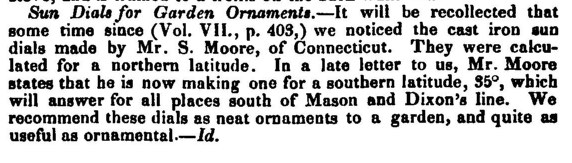
Recently I was lucky enough to purchase a sundial that was manufactured by Sheldon Moore around 1840. The cast iron sundial is almost 10 inches in diameter and the gnomon stands nearly 5 inches high. It will keep perfect time from as far north as Montpelier, Vermont and as far south as Washington D.C.

I found it online at Delaney Antique Clocks (delaneyantiqueclocks.com) which is located in West Townsend, Massachusetts. One of the store’s owners, John Delaney has been featured many times on PBS’s Antique Road Show.  Imagine my surprise when I googled “sundial manufactured by S. Moore  Kensington, CT”, and as it turned out there was one for sale. I quickly emailed John Delaney and asked for a price. He replied that it was $150. I considered haggling with him but thought better of it and paid the full asking price plus shipping. Did I pay too much? Maybe, but this was a rare opportunity to have a treasured family artifact. Truth is I probably would have paid more.

sundial1
New Genesee Farmer, Vol. 3 No. 6, pg. 88

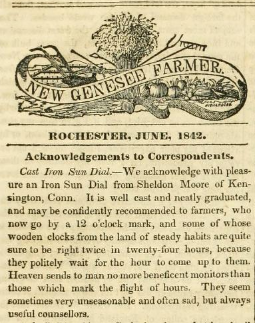
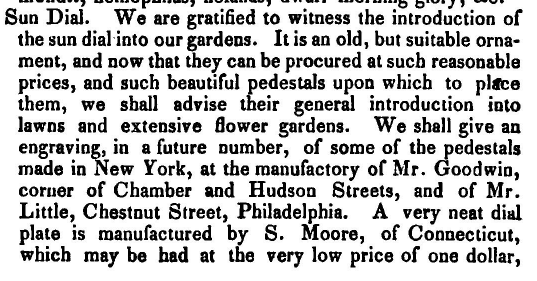
This is not the first time I’ve seen a Sheldon Moore sundial. In October, 2014 I was able to see one at the Connecticut Historical Society in Hartford. That sundial, which is blueish in color and not pictured here, was donated to the Historical Society by the Moore family in 1947 (I’m not sure by which Moore’s). An article published in the Connecticut Historical Society Bulletin in October, 1947 describes Sheldon Moore’s sundial business, which is believed to have existed between 1840 to 1841 and was abandoned due to a small profit margin. I did however, find an article published in the New Genesee Farmer dated June, 1842. The 1947 Bulletin article was reprinted in December, 2008 in The Compendium, a quarterly journal published by the North American Sundial Society. The article goes into great detail about the cost of manufacturing the sundials, and in a nutshell, it cost .50 cents to make one and each sold for a dollar. Now, given inflation over the last 170 years, I think I got a pretty good deal.

sundial3
The Magazine of Horticulture, Botany, and All Useful Discoveries and Improvements in Rural Affairs, Vol. VII, pg. 403

sundial2
Vol. VIII, pg. 312

If you would like to read The Compendium article, it can be found online at http://sundials.org/index.php/dial-resources.

________________________

Last summer I bought a first edition Poems by James G. Percival, which I found online on eBay. I think I paid $50 for it. Since discovering that Sheldon Moore was a close, lifelong friend of Percival I’ve become somewhat fascinated by this strange, eccentric man. I’ve done a lot of research on him and even read some of his poetry. I’ve never been much of a poetry reader so I have nothing to compare it to, but I really like his writings. My favorites are Prometheus I and II and The Dream of a Day. Percival was very popular in his day but his work hasn’t stood the test of time and today his books are hard to find. That being said, the book I bought is in rough shape and the back cover is literally hanging by a string, and it probably isn’t worth the $50 I paid for it. But, as I discovered, this little book had it’s own story to tell.

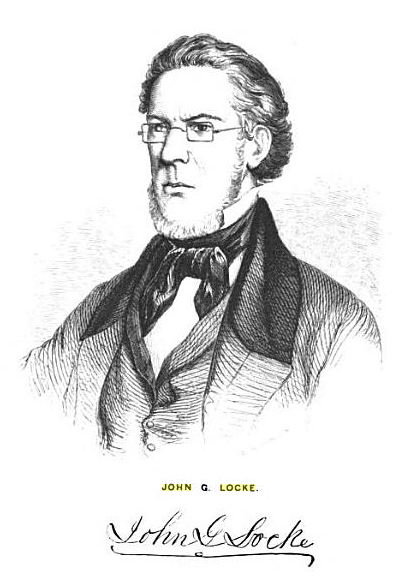
Written on the first page is, “John G. Locke 1826”. In the back of the book this same John G. Locke wrote, “May 25th 1826. Heading for the Mona Passage on the James Coulter -J.G.L.” Some research by yours truly turned up some interesting information.

117

John Goodwin Locke was born in Ashby, Massachusetts on April 1, 1803 and died in Boston on July 22, 1869. On October 25, 1829 he married Jane Ermina Starkweather of Worthington, Massachusetts. Mrs. Locke was a poet herself and her most popular work was Boston: A Poem published in 1842. In later years, John G. Locke was a lawyer but early on he was in the mercantile business and in 1826 he went to Caracas, Venezuela as an agent for a New York commercial house. It’s said that he returned the same year because business was unprofitable. But his return may have had more to do with regional uprisings throughout Venezuela. Newspaper articles from the time reported that the brig James Coulter had arrived in New York on May 28, 1826 and had brought news from Venezuela about the revolution brewing in that country. John G. Locke appears with five other merchants on the James Coulter’s manifest when it arrived in Falmouth, Massachusetts from Venezuela in June, 1826.

jgl2
From “The Book of Lockes”

But what I personally found most fascinating about John G. Locke was that he was a genealogist. In 1853 he published two books, The Book of Lockes and The Munroe Genealogy. He was also a member of the New England Historical Society.

In the beginning of Percival’s book of poems he quoted Robert Southey, “Go little book, from this my solitude, I cast thee on the waters-go thy ways. And if, as I believe, thy vein be good, the world will find thee after certain days”. I know my little book traveled on the waters, in late May, 1826. It left Venezuela and sailed the strait between Hispaniola and Puerto Rico known as the Mona Passage on the James Coulter on route to New York and ultimately Falmouth. In 2015 it somehow found it’s way to me in Connecticut, and just days after receiving it I brought it with me to Kensington when I photographed Percival’s home where much of the book was written in 1820. Thus completing the little book’s journey.

Sources:

  • ancestry.com
  • wikipedia.org
  • The New England Historical and Genealogical Register and Antiquarian Journal, Vol. 25, pg. 92 (1871)

From Scholar to Educator (1818-1820)

Possunt quia posse videntur (They can because they think they can) -Virgil

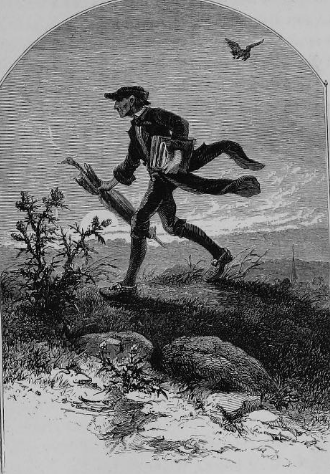
In an application for a United States passport I’ve found a physical description of Sheldon Moore. Written in his own hand, he describes himself as being 5’11” (rather tall for his time), dark grey eyes, light complexion, with a thin, slender face, his mouth and chin were slightly disfigured from a childhood burn. For some reason, maybe because he had been a teacher, I often imagine him looking like Ichabod Crane from The Legend of Sleepy Hollow.

ichabod crane
“The Legend of Sleepy Hollow by Washington Irving (1875)

Sheldon battled health issues his whole life and was often sick. As a boy he probably wasn’t healthy enough to play outside with the other children and this may explain why he was an avid reader and lover of literature. Among his siblings he emerged as the intellectual one of the family. Sheldon was the only one of Roswell Moore’s 12 children that received a college education. Roswell paid Sheldon’s tuition at Yale University and may have chosen his course of study, Law. Roswell, or “Squire” Moore as he was known in Southington was a State Legislator in the Connecticut House of Representatives from 1807-1821 and a Justice of the Peace. So it’s quite possible that Squire Moore desired to have an actual lawyer in the family.

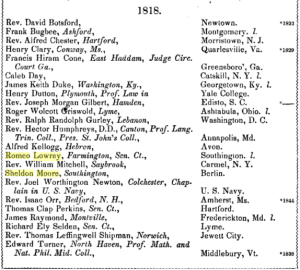
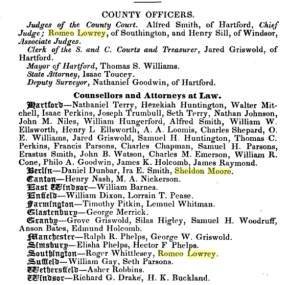
Sheldon attended Yale with his friend Romeo Lowrey, who was also from Southington and also studying law. Both young men graduated Phi Beta Kappa in 1818. Yale President, Jerimiah Day personally recommended Romeo Lowrey for a position near Winchester, Virginia as a tutor for a family. Sheldon took a job as a teacher near Vansville, Maryland just outside Washington D.C.

romeo2
Catalogue of the Connecticut Alpha of the Phi Beta Kappa, Yale College, 1852

These were exciting times, not just for Sheldon and Romeo, but for other friends from Southington. Truman Dunham (Sheldon’s second cousin) was in Cincinnati, Ohio and Augustus Goodsell was in Charleston, South Carolina. In letters written at the time, the men kept track of each other’s movements and welfare.

Sheldon visited Washington at least a couple of times while living in Maryland. But at that time, it had only been four years since the British had torched the city during the War of 1812, so the city may not have been much to look at. Sheldon became fascinated with the Congress and his father commented in a letter, that Sheldon had written more about the Congress then what was happening in his own life.

washington
U.S Capitol After Burning by the British (1814) by George Munger

In January, 1819 Sheldon wrote to Augustus Goodsell that all was going well with the school and he was enjoying good health. However, a month later he wrote his father complaining that he had been quite ill and had been missing school. The details of his illness take up a page and a half of the four page letter, and contains a heads up that if he didn’t feel better soon he would be closing the school and returning home in a few weeks.

He had only planned to stay a year in Maryland and then return to Connecticut, so it’s unclear if the illness drove him home early or he came home when his time in Maryland was up. But in March of 1820 he was back in Southington and apparently unemployed. Romeo Lowrey, who had returned from Virginia after being away a year, was now working in the office of Judge Ansel Sterling in Sharon, Connecticut (Sterling was elected to Congress the following year and served in the House of Representatives until 1825). Romeo wrote Sheldon and told him he had recommended him to Reverend David L. Perry, who ran the Sharon Academy and was looking for a teacher. The pay wasn’t good but the Academy had plenty of books. Sheldon took the job.

Again Sheldon only planned on staying at this teaching job for one year. But by July of 1820 he was complaining about low wages and was already looking to return home. Roswell Moore was now very dissatisfied with his son, partly because the expense of Sheldon’s education had still not been repaid. Sheldon’s brother, Oliver wrote him a letter in which he, as delicately as possible, tried to explain their father’s position, while remaining supportive of his brother’s decision. Oliver also echoed the sentiments of Romeo Lowrey four months earlier, reminding Sheldon that making some money was better than making none and quoted Proverbs 10:4 to prove his point (He becometh poor that dealeth a slack hand: but the hand of the diligent maketh rich). It’s unclear if Oliver’s words swayed Sheldon and he completed his year at the Sharon Academy.

summer school
Connecticut Common School Journal, Vols. 1-4 (1842)

In the years to come Sheldon would try his hand at other professions besides teaching. Though he did continue to teach on the side. As early as 1831 he was teaching Sunday School in Kensington. From 1832-1834 he was the Sunday School Superintendent for Berlin. He held this position again from 1836-1840. In 1842, he was on a committee, along with Reverend Royal Robbins, to improve the schools in Berlin. The committee made Emma Willard Superintendent of Schools in Berlin. Mrs. Willard had recently retired from the Troy Seminary School in Troy, New York, which she had founded.

Romeo Lowrey passed the Bar in 1820 and returned to Southington where he started a law practice. He was later Justice of the Peace, an Assistant Judge and represented Southington in the Connecticut House of Representatives and the State Senate. He died in Southington on January 30, 1856 and is buried in Oak Hill Cemetery, not far from Roswell Moore.

Sources:

  • U.S. Passport Applications, 1795-1925, Ancestry.com
  • Autobiography of Nelson Augustus Moore of Kensington, Connecticut
  • Sheldon Moore Papers Yale University Manuscript (MS 992)
  • Ecclesiastical and Other Sketches of Southington, Connecticut by Heman R. Timlow (1875)
  • Two Hundredth Anniversary, Kensington Congregational Church (1912)
  • Connecticut Common School Journal, Vols. 1-4 (1842)

Picture Credit:

U.S. Capitol after burning by the British (1814) by George Munger, Library of Congress Prints and Photographs Division, Reproduction number LC-DIG-ppmsca-23076 (Digital file from original item)

romeo1
The New England and New York Law Register for the Year 1835

010
Romeo Lowrey, Oak Hill Cemetery


The Courtship of Sheldon and Susan

385
Susan L. Wife of Sheldon Moore, died Mar. 20, 1897, age 87 yrs.

Susan Langdon Dickinson was born in Kensington on November 20, 1809. She was the daughter of Jesse and Chloe (Allen) Dickinson and was named after her grandmother, Susannah (Langdon) Hooker Dickinson.

Susan’s roots in Kensington ran very deep and she is seemingly related to everyone in the area either by blood or marriage, including Sheldon’s brother in law, Charles C. Langdon, the husband of Sheldon’s sister, Eliza. Susan and Charles Langdon were distant cousins who had a mutual 3rd great grandfather, John Langdon. Susan also shared a mutual uncle and aunt with the poet, James G. Percival. Percival’s uncle being Matthew Hart, Jr. and Susan’s aunt being Urania (Hooker) Hart.

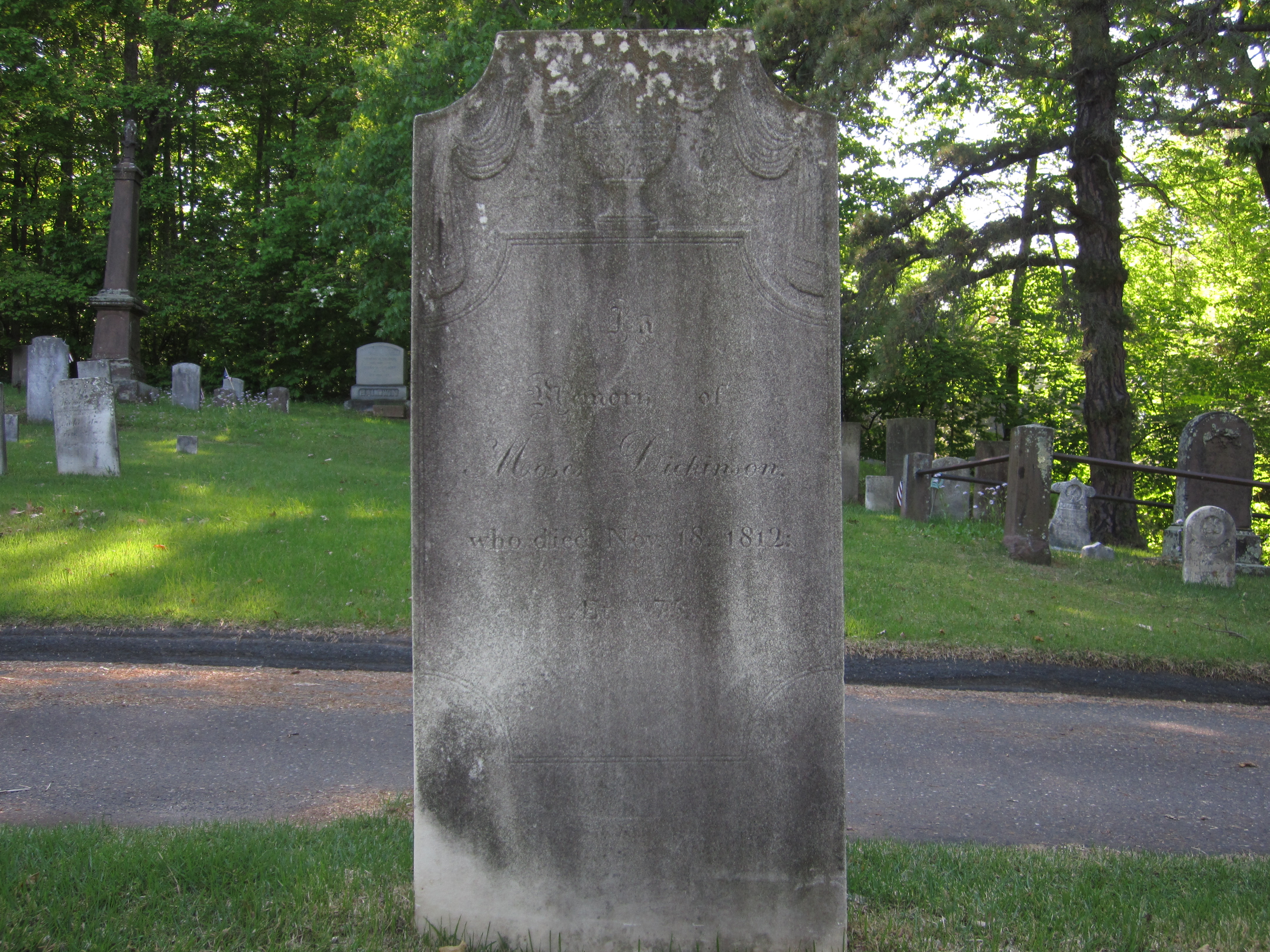
Susan’s grandfather, Moses Dickinson was born in Wethersfield but had come to Kensington before 1760. That being the year he married Lydia Cole. He owned land along, what is today, High Road and Four Rod Road. It is said that he donated the land for West Lane Cemetery and that he was the first person buried there. He died in Kensington on November 18, 1812.

018
In Memory of Moses Dickinson, who died Nov. 18, 1812: Age 75 yrs.

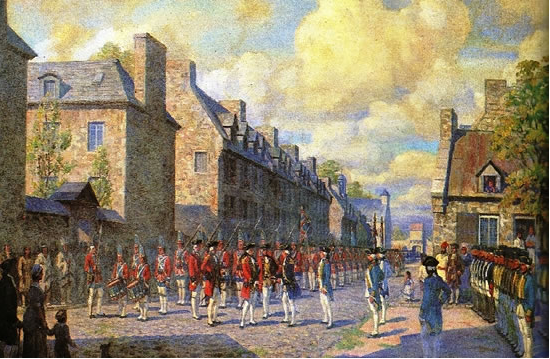
Moses fought in the French and Indian War from 1759-1760 and was enlisted in General Phineas Lyman’s 1st Connecticut Regiment, Captain Whittlesey’s Company. Also serving in this regiment and company was Kensington native, Ashbel Hooker. Hooker had enlisted as a clerk in 1758 and was later promoted to a sergeant and then to ensign. He married Susannah Langdon in Berlin on January 31, 1760 and then returned to duty. Their daughter Urania was born May 11, 1760 (these dates probably mean that Susannah was already with child before they married). Ashbel Hooker died September 6, 1760 in Canada two days before the French surrendered Montreal to British forces. It is very likely he never met his daughter.

montreal
Surrender of Montreal, September 8, 1760

Moses and Lydia’s first and only child, Seth was born February 7, 1762 and it’s possible that Lydia died during childbirth (no death record found). Two years later on March 8, 1764, Moses married his fallen comrade’s widow, Susannah Hooker. Their first child, Jesse (Susan’s father) was born August 12, 1764 (again the dates don’t add up). Their next two children, Ashbel and Lydia were named in honor of their spouses. Then came Susannah, Moses, Azel and Lucy. These seven children plus Seth and Urania gave them quite a large family.

But a large family didn’t stop Moses from enlisting again after the Revolution started. In 1776 he joined Bradley’s Battalion, Wadworth’s Brigade and eventually reached the rank of ensign. Also in this brigade was another Kensington resident, Susan’s maternal grandfather, John Allyn who rose to the rank of captain later serving under, still another Kensington resident, General Selah Hart.

So to reiterate, Susan’s family had a rich and colorful history in Kensington.

Sheldon Moore and Susan Dickinson probably met at a young age, the Dickinson land being so close to Roswell Moore’s mills in Kensington. They were engaged in 1831 (no intention found) but no date had been set. In late June of that year Susan took a trip to Alden, New York to visit her older sister, Sophia, the wife of Horace Stanley, and her nieces Virginia and Harriet. Susan’s father had died the previous summer and her mother and fiancee were home in Connecticut, and 21 year old, unescorted Susan was probably feeling a sense of independence she had never known.

On the day she arrived in Alden, her cousin Sophronia Dickinson arrived from Attica, New York. And after two weeks, Susan, Sophronia and the Stanley’s made the twenty mile trip to Attica to visit Susan’s aunt and uncle, Moses and Rebecca (Hart) Dickinson.

In a letter to Sheldon dated August 1, 1831, Susan wrote that her Uncle Moses looked very much like her father. So much so in fact that her niece Harriet kept calling him Grandpa. Susan, an avid churchgoer, was also attending a lot of church sermons, both Methodist and Presbyterian, she preferred the latter.

Susan also dropped a bombshell, telling Sheldon that she may not be returning in the fall as previously planned. Her sister really wanted her to stay through the winter. She knew her mother would not consent so she was asking for Sheldon’s consent instead.

Sheldon’s response arrived from Southington thirteen days later. He jokingly told Susan that if she didn’t return in the fall, then he would be forced to go to Alden to be with her, and he was sure that Horace Stanley didn’t want that. He was serious though when he told her that he felt her staying through the winter was unnecessary and he would not give his consent. He was also sure her mother wouldn’t either. He then gave her a couple of options on how to return by the fall. One being to return with Alpheus Woodruff, who would be in Attica visiting relatives and would be returning by September 1st. The other option was to return a little later with Sheldon’s brother, Roswell and his wife Lucy who would be in Utica. Sheldon told Susan he really wanted to see her and asked that she not give any more thought about staying past fall.

How Susan returned isn’t known, but she didn’t stay in Alden through the winter as she had hoped. Susan and Sheldon were married in Kensington on November 1, 1831.

Sources:

Ancestry.com

Fold3.com

Wikipedia.org

Rolls of Connecticut Men in the French and Indian War, 1755-1762, Vol. 2

Sheldon Moore Incoming Correspondence Connecticut Historical Society Manuscript (55335)

Sheldon Moore Papers Yale University Manuscript (MS 992)

Information that Moses Dickinson donated the land for West Lane Cemetery was provided by Sallie Caliandri from the Berlin Historical Society. She cites her source was the Kensington Congregational Church Records found in the Local History Room at the Berlin-Peck Library.

Carved in Stone

444
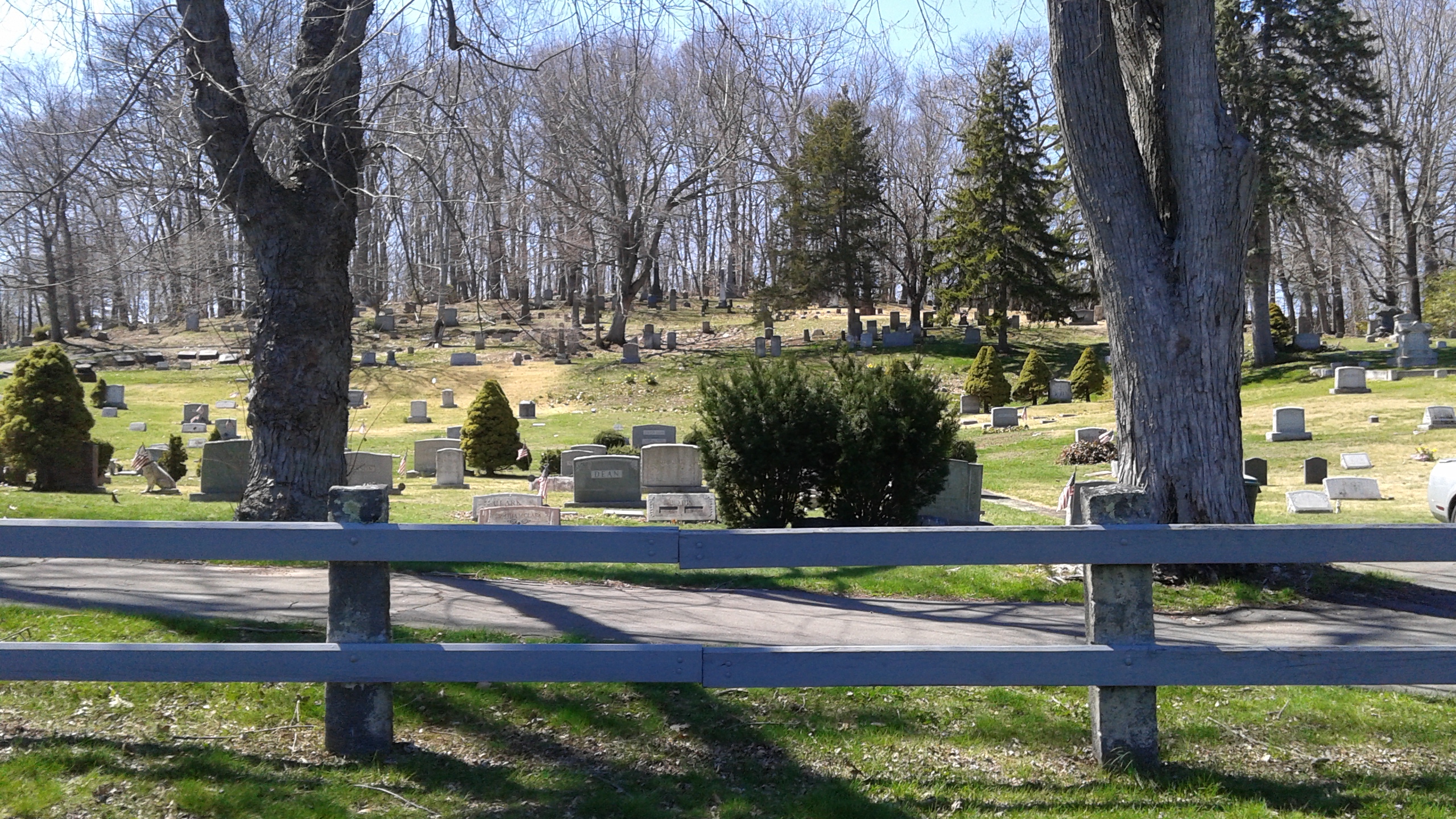
West Lane Cemetery, Kensington, Connecticut

Let’s talk of graves, of worms, and epitaphs;  Make dust our paper and with rainy eyes, write sorrow on the bosom of the Earth. Let’s choose Executors and talk of wills; And yet not so -for what can we bequeath, save our deposed bodies to the ground?

-William Shakespeare (Richard II)

West Lane Cemetery in Kensington isn’t actually on West Lane, it’s on High Road. It’s situated on the side of a hill and has only a narrow paved path to get to the top. The path isn’t really wide enough for a hearse. In March, 1990 my grandmother was buried there, and me, my brother and cousins, who were pallbearers, had to carry her casket up the relatively steep hill, almost to the top. This was twenty years before I started doing genealogy, and I had no idea at the time how important this cemetery is to my family history or how many relatives we were walking over as we made our way up the hill to my grandmother’s final resting place next to my maternal grandfather.

The Moore’s that my mother knew were in Southington on Andrews Street. These were her father’s maternal uncles, aunts and cousins and they visited them often when my mother was growing up. So in 2010, I was perplexed as to why my grandparents were buried in Kensington. They’re buried in a plot with my grandfather’s parents (my great grandparents), Charles and Sara (Moore) Kellogg. On a visit to West Lane with my mother that year I asked her why they were buried in Kensington and not Southington. Mom, who has a habit of answering questions she doesn’t know the answers to with simple responses, looked down the hill and scanned the landscape and replied, “I think they really liked the view”. It made sense, it really is beautiful there.

However, there was more to the story. Sara Moore was the daughter of Charles and Sarah (Horton) Moore who are also buried in West Lane. Charles Moore owned a farm and at least two houses on Andrews Street in Southington and died there in 1913. So it still didn’t make any sense why he was buried in Kensington. More research revealed  that Charles was the son of Sheldon and Susan (Dickinson) Moore and he was born in Kensington in 1834 and lived there until he married in 1857. Mystery solved.

But going back another generation to Sheldon’s parents, Roswell and Lovina (Phillips) Moore, I found Roswell lived on Andrews Street in Southington, a mile north of what was later Charlie Moore’s home and farm.

Roswell and Lovina Moore are buried in Oak Hill Cemetery in Southington along with Roswell’s parents, Roswell and Desire (Dunham) Moore. Also buried there are Roswell and Lovina’s sons, Eli, Nelson, Charles and Lurian, and their daughters, Mrs. Dimmis Grannis and Mrs. Sarah Frisbie. Nelson and Lurian being the only two of Roswell’s twelve children not to survive to adulthood.

Roswell Moore owned R. Moore and Sons or Moore’s Mills in Kensington. Sons, John, Roswell, Jr., and Oliver were sent there to work the mills. John later removed to West Springfield, Massachusetts and is buried in Agawam Center Cemetery in Agawam. Roswell, Jr., Oliver, and later Sheldon all made Kensington their home and all three died there and are buried in West Lane Cemetery.

The first Moore buried in West Lane was Caroline (Leonard) Moore, the first wife of Oliver, who died in 1829. According to findagrave.com there are 48 Moore’s buried in West Lane, all of them related. The one exception being Pauline (Moore) Canfield who was the daughter of Walter and Adeline (Castle) Moore. Walter Moore was in no way related to these Moore’s, but when Adeline divorced him and married Roswell Allen Moore, Jr. (great grandson of Roswell Moore) sometime after 1900, Pauline Moore became Roswell Allen Moore’s stepdaughter, thus connecting her to these Moore’s. There are still others in West Lane who are also related to this line of Moore’s but don’t go by the name Moore, including my grandfather.

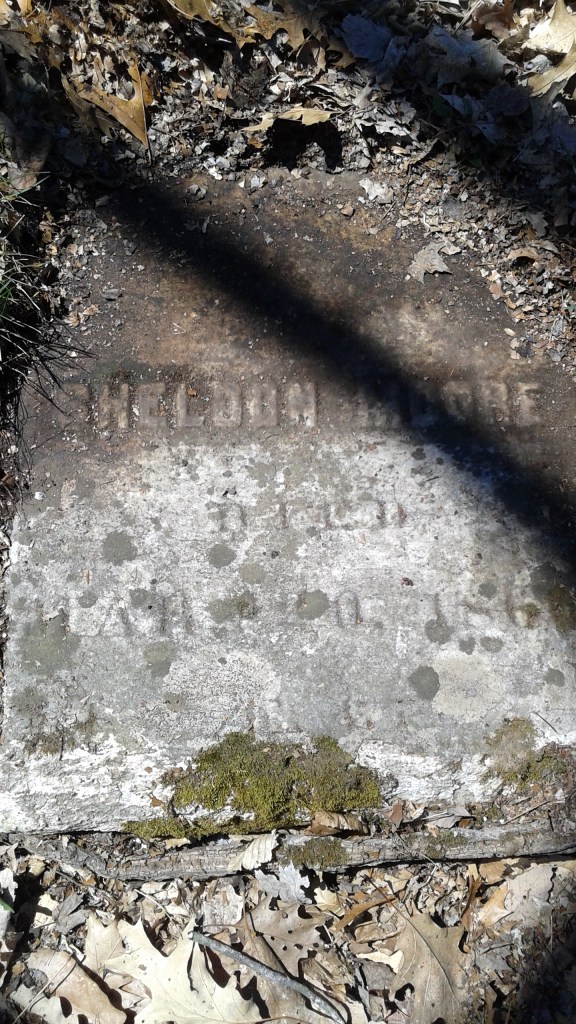
Sheldon Moore is buried next to his wife adjacent to the paved path near the top of the hill. His headstone fell over before 2010 and the soft earth at West Lane is slowly claiming it. I’ve visited the cemetery at least once a year for the past six years. When I do, I make sure to brush the leaves, dirt and grass off his stone, revealing his name and epitaph so that his final resting place will not be lost just yet.

384
Sheldon Moore, died Mar. 20, 1866, age 67 yrs.

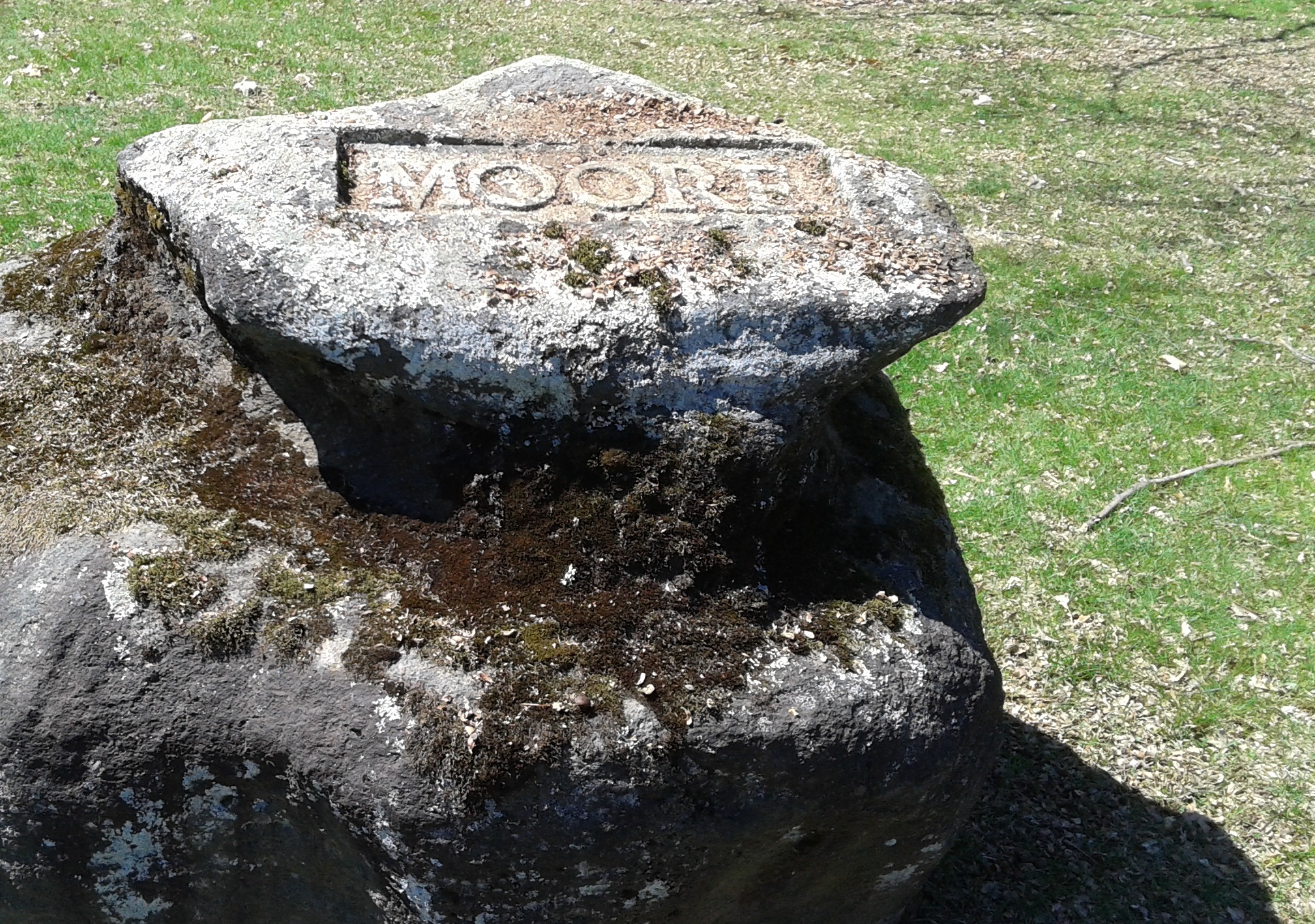
There’s a boulder in West Lane that, according to Ethelbert Allen Moore, was once in the middle of Sheldon Moore’s apple orchard. Carved into the top of it is the name, Moore. I once wondered why West Lane wasn’t called High Road Cemetery. I’m beginning to wonder why it’s not called Moore Cemetery.

Sources:

  • findagrave.com
  • ancestry.com
  • Hale Collection of Cemetery Inscriptions and Newspaper Notices, 1629-1934
  • Tenth Generation by Ethelbert Allen Moore (1950)

405

I’m a descendant of the following people buried at West Lane Cemetery:

  1. Sheldon Moore
  2. Susan (Dickinson) Moore
  3. Charles Moore
  4. Sarah (Horton) Moore
  5. Charles S. Kellogg
  6. Sara (Moore) Kellogg
  7. Charles S. Kellogg, Jr.
  8. Frances (Trottier) Kellogg
  9. Moses Dickinson
  10. Susannah (Langdon) Dickinson
  11. Jesse Dickinson
  12. Chloe (Allen) Dickinson
  13. John Allyn
  14. Ruth (Burnham) Allyn

Set in Cement

old double bridge
“The Double Bridge. Old Cement Mill in Distance” Courtesy of the Berlin Historical Society. Used by permission.

In 1925, 21 year old Idabelle Lindsley of Kensington photographed a sign near Steel Shop Pond on the Mattabassett River that read, “CEMENT MILL, Site of first cement mill in United States, 1829”. This is a rather bold and entirely untrue statement. The sign should have read, “Site of the first blue limestone, hydraulic cement mill in Connecticut, 1826”. Though even this statement is debatable.

Fact: A cement mill owned by Roswell Moore of Southington and operated by his sons, Roswell, Jr. and Oliver did exist in Kensington from at least 1826 until the 1850’s under the name R. Moore & Sons.

Fact: Hydraulic or water cement was being manufactured in New York near the Erie Canal as early as 1818.

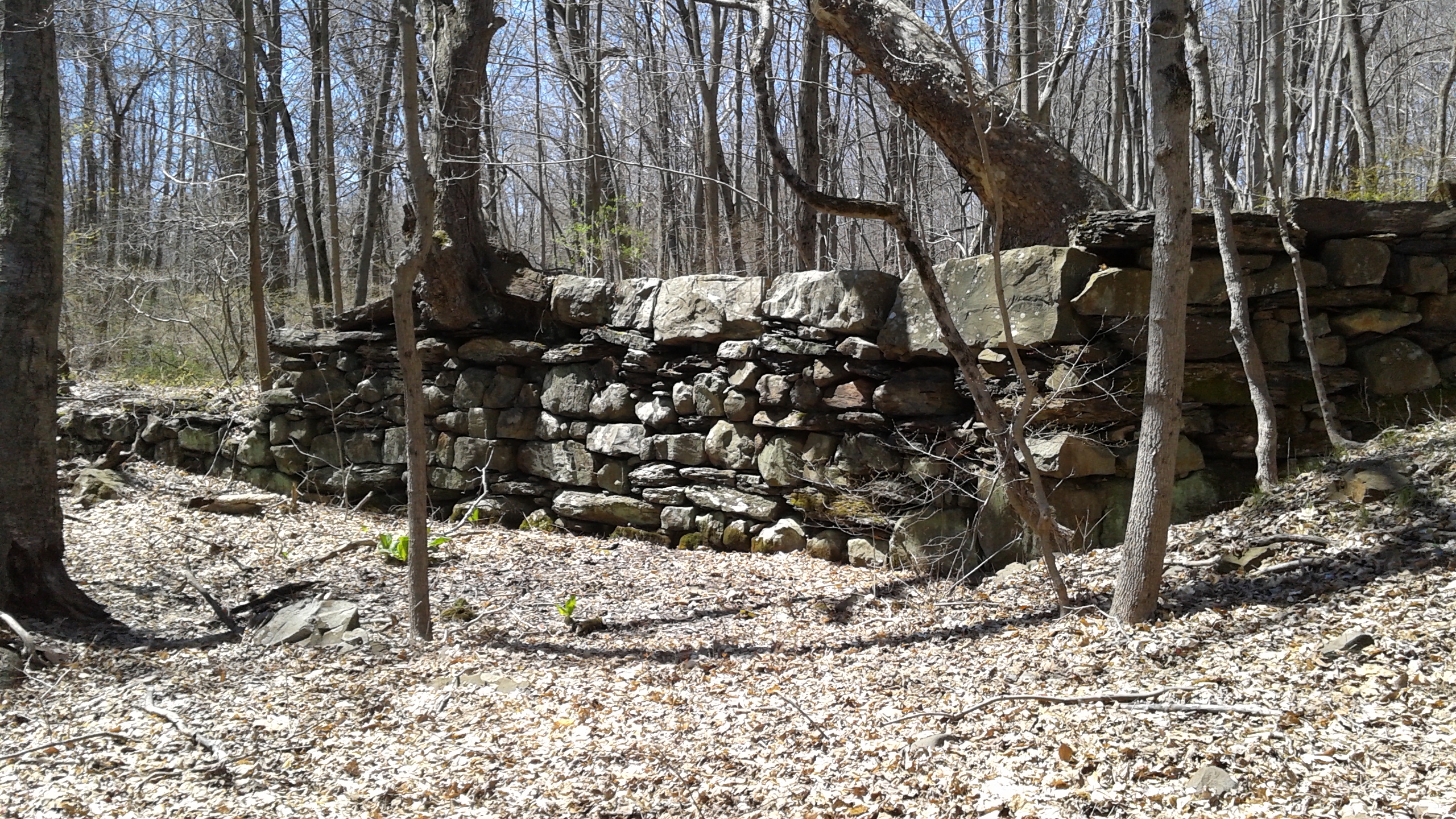
In 1801, Roswell Moore had bought Solomon Winchell’s half of a grist and carding mill that Winchell co-owned with Dr. James Percival (father of poet James G.), and by 1817, Roswell owned the mill entirely, following the sudden death of Dr. Percival. This mill, between High Road and Glen Street, just west of the Congregational Church, was also used in the production of linseed oil. Later a saw mill was added. Just to the south another mill was built for manufacturing kiln dried meal, and it was this mill that was eventually converted into the cement mill. These mills collectively were known as “Moore’s Mills”.

But the story of the cement mill begins in Southington with Sheldon Moore and his friends, Gad Andrews (son of Luman Andrews) and Anson Merriman.

water cement
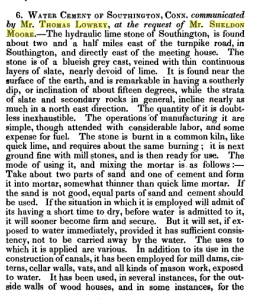
Excerpt from the American Journal of Science and the Arts, Vol. 13 (1828)

The Luman Andrews homestead and farm was at the corner of what is now Andrews and Woodruff Streets, not far from the Berlin line. Almost a mile north was Roswell Moore’s property and between them was Anson Merriman’s home.

Sheldon Moore had graduated from Yale in 1818 with a law degree and had worked as a teacher in Vansville, Maryland and Sharon, Connecticut. He shared a mutual interest in science with his friends Andrews and Merriman and subscribed to the American Journal of Science and the Arts, which was published by his old college professor, Benjamin Silliman. In 1825, the three men had read an article in the journal about limestone being used to make cement for the Erie Canal. In the early 1800’s the young country was very much in need of a water limestone or hydraulic cement that would harden in water to be used to construct canals, dams and bridges. Merriman remembered seeing an outcrop of a blue limestone on the Andrews property and wondered if it might be used to make cement.

Sheldon then wrote Professor Silliman asking him if this blue limestone might have the necessary properties to make hydraulic cement, when Silliman didn’t respond immediately, an anxious Anson Merriman wrote several more letters. Professor Silliman’s response to Sheldon was simple, an experiment was needed using the blue limestone. The rock would need to be burnt, then pulverized, mixed with sand and left in water to see if it would set. The experiment was a success and plans were made to begin manufacturing.

434
Remnants of one of the Moore’s mills in Kensington on the Mattabassett River

But soon after the blue limestone was also discovered on the Moore property. It is here that the Moore and Andrews firms appear to have parted ways. Roswell Moore seems to have been a shrewd businessman. So why would he want to share the profits of this new enterprise with Luman Andrews? After all, he possessed his own supply of blue limestone, and the kilns that were needed to burn it were already being constructed just south of the Moore home. Plus, he had something that Andrews didn’t; a working mill that would be needed to grind the limestone.

Not only did Luman Andrews not have a mill, he didn’t even possess the water power necessary to power one. This was remedied in July of 1829 when they leased and later purchased land from Seth Cowles of Berlin, on what is now Carey Street in Southington, where they constructed a dam and mill.

The Moore’s also had all the key people needed to run a successful cement business. Younger brother Eli Moore handled things on the Southington side, which included quarrying the blue limestone and burning it in the kilns. The quarry being located across the road from the Moore homestead where the Wassel Reservoir is now. The limestone was then transported 3 1/2 miles away, via Carey Street between the two Hart ponds, to the mill in Kensington. Here, Roswell, Jr., an expert miller, ground the limestone. It was then put into barrels and brought to Middletown where it was shipped to agents and suppliers who sold it to customers as far away as the West Indies. Oliver Moore, the engineer of the family, was in charge of building dams, mills, and probably the kilns. Sheldon Moore acted as comptroller, accountant and handled legal affairs. And Roswell Moore was the owner and CEO, who not only used his business skills to find suppliers and customers, but also handled advertising.

028
Wassel Reservoir, across from Roswell Moore’s house in Southington, Connecticut. Site of the Moore’s quarry.

On a personal level, this venture was exactly what Sheldon needed to redeem himself with his father. Roswell Moore, who had paid Sheldon’s tuition at Yale, had viewed his son’s education as a kind of investment. An investment that up to this point, that had not paid off. The cement business became R. Moore & Sons most profitable enterprises.

One of the first customers, of what was still Moore & Andrews, was the Farmington Canal Company. The Farmington Canal operated from 1828-1848 and ran from Northampton, Massachusetts to New Haven, Connecticut. Cement from Southington was used to build bridges, locks, piers, abutments and culverts and a stone dam that crossed the Farmington River. Farmington Canal Company began purchasing cement from Moore & Andrews as early as 1826. The canal became obsolete with the coming of the railroad, which in many sections, ran adjacent to the canal. Today the railroad is also gone and has been replaced by the Farmington Rail Trail, a bike path.

200
Sign on the Farmington Rail Trail in Simsbury, Connecticut

By 1828, there was another competitor from Southington in the cement business, the firm of Barnes & Bradley which was operated by Liva Barnes and Jason Bradley. Their quarry was located south of the Andrews homestead and they built their mill on the property of David Sloper. The new competition drove the price of cement down, but in spite of this, the Moore’s cement business continued to turn a profit for the next three decades.

However, what was once considered an inexhaustible supply of blue limestone in Southington was beginning to dwindle by the early 1850’s. Barnes & Bradley had already run out and the Moore and Andrews firms were running low. Roswell Moore and Luman Andrews were now dead and what was left of the cement businesses was being run by Eli Moore and Bennett J. Andrews (son of Luman), who resurrected the original firm of Moore & Andrews.

By the late 1850’s the manufacturing of cement by Moore & Andrews had ceased completely. A few years prior, Roswell, Jr. retired from milling and became deacon of the Congregational Church in Kensington. Oliver Moore converted the cement mill into a shop that manufactured steelyards and gardening tools. And Gad Andrews had also retired, turning his attention to genealogy.

The next generation of Moore’s and Andrews’ both tried to take credit for being the first to manufacture hydraulic cement. In his unpublished autobiography, Nelson Augustus Moore (son of Roswell, Jr.) claimed that R. Moore & Sons had been the first to successfully market hydraulic cement and that Anson Merriman’s attempts to market the cement had failed. In his book, Ecclesiastical and Other Sketches of Southington, Connecticut published in 1875, Heman R. Timlow also claimed that Gad Andrews and Merriman’s cement business had actually failed. Although Anson Merrimans role in the cement industry is unknown it’s certainly not true that the Andrews firm had failed.

In 1924, Frank D. Andrews (son of Bennett J.) wrote a privately published and incredibly informative book called, History of the Discovery of Water-Limestone and Early Manufacture of Cement at Southington, Connecticut  in which he doesn’t claim, but certainly implies that the Andrews family were the first in the State to manufacture cement.

In his aforementioned autobiography, N. A. Moore vividly describes the mills in Kensington, including the trees and foliage surrounding the streams and ponds near the mills and the day to day operation of the mills. Moore also sketched and painted several pictures of the mills in Kensington. Around 1865, he briefly reopened the cement mill in order to produce enough cement to build his house on High Road, next door to his father’s home, that he called “Stonehouse”.

414.jpg
Nelson Augustus Moore’s “Stonehouse” in Kensington, Connecticut

Sources:

Early Cement Manufacture in Connecticut by Clarence N. Wiley, presented at the 49th Annual Meeting of the Connecticut Society of Civil Engineers, Hartford, Connecticut, Feb. 22, 1933

History of New Britain with Sketches of Farmington and Berlin by David N. Camp (1889)

History of the Discovery of Water-Limestone and Early Manufacture of Cement at Southington, Connecticut by Frank D. Andrews (1924)

Autobiography of Nelson Augustus Moore of Kensington, Connecticut

Sheldon Moore Papers Yale University Manuscript (MS 992)

Connecticut Mill Sign, Berlin photographed by Idabelle Lindsley Tatro (1925) Connecticut Historical Society Object Number 1977.92.297

For more information please read Addendum to “Set in Cement”

422

424

432

438

Sheldon Moore Place

032
Sheldon Moore’s Home in Kensington

Beneath a broad crowned oak, on a sloping hill o’erlooking wide the lovely region round.  On a soft thick turf I lay; the air was still- distinctly heard was each remotest sound. The clacking wheel in a cornfield, at the mill the circling ‘plash, and far the faint rebound of low and bleat from mountain side, the stir of insect swarms, the drone bee’s hum and swirr. -James Gates Percival “The Dream of a Day”

This house was originally built by Mathew Hart in 1759. Hart served during the Revolutionary War as a Private in Captain Selah Hart’s Company, Colonel Wolcott’s Regiment, and later as a Corporal in Captain James Stoddard’s Company, Colonel Moseley’s Regiment. He further contributed to the war effort by producing bullets for the Continental Army made from the lead from the nearby mine. He was also the maternal grandfather of the poet, James Gates Percival.

mathewhartplace2
Circa 1900

Around 1800, Hart removed to De Ruyter, New York and the house was sold to Norman Winchell. In 1813, Winchell sold it to Oswin Percival (brother of James G). And in 1824, Percival sold it to Sheldon Moore’s father, Roswell.

Sheldon’s brothers, Oliver and Roswell, Jr. and their respective families shared the house from 1824, until Roswell, Jr. built his own home on nearby High Road and Oliver temporarily left Kensington, going first to West Springfield, Massachusetts, and later Miller’s Falls, a section of the towns of Erving and Montague originally known as Grout’s Corner. Oliver’s daughter, Nancy, and Roswell’s son, Nelson Augustus (the artist), were both born in this house on August 2, 1824.

On August 13, 1831, Sheldon Moore wrote his fiancee’, Susan L. Dickinson and told her that his brother Oliver was moving to Massachusetts and leaving the house to them. They occupied the house until Sheldon’s death in 1866.

After Sheldon’s death, Susan L. Moore lived with her children until her own death in 1897.

From at least 1900-1939 the house was owned by Oliver Moore’s granddaughter, Alice and her husband Isaac Porter.

Sources:

  • “Tenth Generation” by Ethelbert Allen Moore (1950)
  • “Autobiography of Nelson Augustus Moore of Kensington, Connecticut” (Unpublished)
  • “Sheldon Moore Papers” Yale University Manuscript (MS 992)
  • “Sheldon Moore Place” Photograph by Nelson Augustus Moore, Connecticut Historical Society Object 2006.65.2. Inscription: ‘Sheldon Moore Place. Where I was born and in the same day Nancy Moore (my cousin) daughter of Oliver Moore she died at Millers Falls Mass aged 15 years and was buried in West Lane Burying Ground-N.A.M.’

Picture Sources:

  • “Mathew Hart Place” The Connecticut Magazine, Volume 6 (1900) Illustration by Isaac Porter
  • “Berlin Historical Building 024” WPA Architectural Survey 1935-1942, from the Connecticut State Library Digital Archives
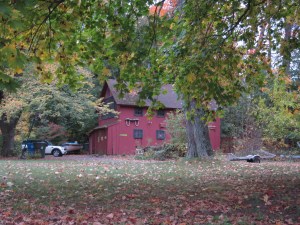
  • “Sheldon Moore’s Home in Kensington” and “The small barn on the property” by spellmanjr October 31, 2014

033
The small barn on the property

Berlin_historic_building_024
Circa 1936