The following story recently appeared in The Tin Horn, the newsletter for the Berlin Historical Society. I have been a proud member of the Historical Society since 2015. About a year ago I read in the newsletter that they were looking for stories about the town. Now clearly they meant stories from people who grew up there or folks who have lived there a long time who could share tales of how the town used to be. I can’t claim to be either, since I didn’t grow up there, nor have I ever lived there. But, I’d been sitting on this story I had written about one of Berlin’s biggest celebrities, the poet James Gates Percival. So I submitted the story, which is quite long for a newsletter, and to my surprise they replied that they would include it in four parts this year (Winter, Spring, Summer and Autumn, 2018). I am truly honored that the story appeared in their newsletter and now take the liberty of posting it here in it’s entirety, with a few edits and a footnote.
-spellmanjr 28 Nov 2018

I’ll live no more, I know the world too well. I’ll trust no longer to it’s soothing voice. Let those who choose, in pain and sorrow dwell. Death is my fondest, death is my only choice.
-James Gates Percival “The Suicide”
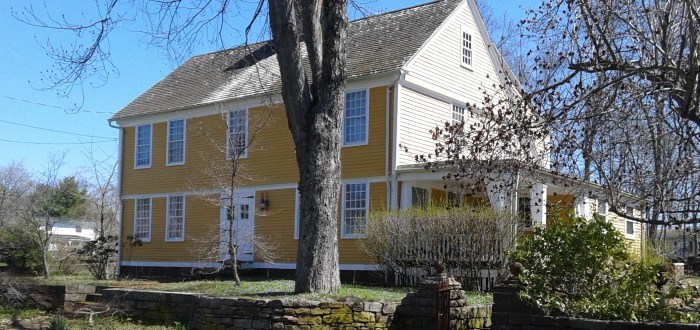
The poet James Gates Percival’s home is located in Kensington on the street that bears his family’s name, just southwest of the Kensington Congregational Church. It’s not the house he was born in but the home he grew up in, his father, Dr. James Percival having built it in 1789 when Percival was about 3 years old. It’s also where the poet finished his first book of poems, which was published in New Haven in 1821. The house and the village of Kensington were also the setting of Percival’s alleged suicide attempt in the summer of 1820. The poem, The Suicide, which he started writing in 1816 and completed in 1820, appears in Percival’s first book.
Besides being a poet, James G. Percival was a geologist, botanist, linguist and Medical Doctor. But though he excelled at many different things, living in the real world doesn’t seem to have been one of them. He suffered from depression, as did his mother, Elizabeth (Hart) Percival. He was painfully shy and lived in a self-imposed isolation for most of his adult life. This solitude and the comfort he found in it can be felt in his poetry.
The artist Nelson Augustus Moore, who knew the Percival family personally, once wrote of James and his brothers, Edwin and Oswin, “all three never seemed to belong to this world, extremely sensitive in their natures, of an organization of the finest nerves, they could not bear the rough contact of the world”.
The author Samuel G. Goodrich (aka Peter Parley), whose family lived in Berlin and was a friend of Percival’s, also wrote of him, “His mother was by nature of a susceptible and delicate organization, and she seems to have imparted to her son these qualities, with a tendency to excessive mental development.”
Percival’s life was altered dramatically when he was 11 years old with the death of his father and his sister, Harriet, who died within a month of each other. The elder Dr. Percival was a very successful local physician, businessman and land owner, and he left a considerable amount of property to his three minor sons.
James and his brother, Edwin were sent to Hempstead, Long Island to live with their maternal uncle, Reverend Seth Hart. Described as an, “amiable man of a cheerful an almost jovial temperament”, Reverend Hart’s personality was in sharp contrast to his melancholy nephew. Uncle Seth tried to get young James to break out of his shell and Percival hated him for it. Portions of “The Suicide” were directed towards his uncle, including the verse:
Ye who abused, neglected, rent, and stained that heart, when pure and tender, come and dwell. On these dark ruins, and, by Heaven arraigned, feel, as you look, the scorpion stings of hell.

When he was 16 years old Percival entered Yale College, using some of his inheritance to pay his tuition. As he usually did, he excelled in his studies but struggled socially. He graduated in 1815 second in his class. He would have been first but didn’t wish to be Valedictorian because he wasn’t a good speaker. He was unable to choose a career and took a couple of jobs as a tutor. His mother was now married to Samuel Porter, a local farmer, and James worked on his stepfather’s farm. Unfulfilled, he reentered Yale, this time to follow in the footstep’s of his father and become a physician.
It was around this time that he fell in love with Mary Ann Goodrich, the sister of the aforementioned Samuel Goodrich and Charles A. Goodrich, also an author and the Worthington Parish pastor. James and Mary spent time walking together and reading poetry. But when he admitted his love to her, she announced that she had been promised to another. Mary married Nathaniel B. Smith in 1819.
Still another love was a young woman that he tutored while living in Philadelphia. One day during their studies her hand accidentally touched his. Without saying a word, he not only left her home, but also the city and returned to New Haven. He later wrote her admitting his feelings. She had a family member respond for her that she was not interested. After these two rejections Percival is said to have given up on love forever.
The Life and Letters of James G. Percival was written by Julius H. Ward and published in 1866, ten years after Percival’s death. In recounting Percival’s early days Ward, who had never met the poet, relied on Percival’s family and friends, such as his brother, Oswin, Reverend Royal Robbins and his lifelong friend and neighbor Sheldon Moore to tell his story. It’s important to mention that these men were older by this time and were being asked to remember events that had happened forty or fifty years earlier. It seems that some of the details of these events may have been confused or embellished by the storytellers, or may have been just made up by Ward.
For instance, after graduating from Yale again, this time with a Medical Doctorate, Percival returned to Kensington and began practicing medicine. Ward claims that soon after, Dr. Percival was called to a local family’s home to tend for their children, seven in all, who had contracted a malignant fever that had been ravaging the region. He was unable to check the disease and five of the family’s sons, ages 2 to 12, all died within days of each other. Percival was now unable to bear the responsibility of being a doctor and gave up his practice. But there doesn’t seem to be any record of a family in Berlin, or even the State, losing five children at that time.
Even more questionable are the details of Percival’s suicide attempt in 1820. Ward wrote that Reverend Robbins was walking with Percival when he suddenly began running across a field and ran head first into a wall. Oswin Percival told Ward that James had tried to overdose on Opium. Others had seen him hitting his head on trees or trying to crush his own skull with a large cobblestone. Percival had supposedly considered going to the shore and drowning himself. Finally he decided to go to Middletown and get a gun to shoot himself in the head. He began making his way there when, as Ward writes, “all at once the disease left him; the pressure at his head was gone…and turning about, he went home a sane man”. So, the question is, is this story believable or is it just a tall tale?
Luckily, a firsthand account does exist and is contained in a letter from Oliver Moore to his brother, Sheldon, at that time teaching in Sharon, Connecticut. In the letter, dated July 14, 1820, Oliver wrote that Percival had for some time been telling anyone that would listen, that he just couldn’t live in this world and planned on killing himself. Oliver went on to say, that Percival had decided a week earlier that he would commit suicide after his mother visited him, but that day had come and gone and Oliver hadn’t heard anything else about it.
There were several theories going around Kensington as to why this highly educated man would want to end his own life. Oliver Moore believed that Percival had studied too hard. One Jabez Cowles thought that he hadn’t matured into a man and now was unprepared to function in society. Others believed that Percival, who had spent the remainder of his inheritance to go back to school, just couldn’t bear the thought of being poor. And a few thought that this was a ploy to scare Oswin into giving him some of his property. Ward wrote that the rejections in love and the failure of his medical practice had lead to his decision to commit suicide.
In his memoirs, Recollections of a Lifetime, Samuel Goodrich wrote that Percival had only contemplated suicide during this period of his life, but that his mother (Goodrich’s) had talked him out of it.
It’s unknown if he ever contemplated suicide again. But Edwin Percival is believed to have starved himself to death in Troy, New York in 1848.
James lived out his life as a bachelor, as did both his brothers. Sheldon Moore would later say that he viewed him as a “sinless being”.
Though he made money in his many endeavors he never had any, and he lived in near poverty until his death. After spending a small fortune on his education he later spent another small fortune on his vast personal library, which was comprised of about seven thousand volumes when his executors sold it off in 1860. Oswin was also not good at handling money, and his cousin, Benjamin Hart was forced to declare him incompetent and take over his finances.
Percival himself remains silent on an actual suicide attempt. In the preface of his first book of poems he wrote, “Perhaps some apology may be demanded for ‘The Suicide’. I can only say, it is intended as a picture of the horror and wretchedness of a youth ruined by early perversion, and the causes of that perversion. It is not without moral to those who can see it. I wish to impress on the minds of all who read it, the great dangers of indulging the evil propensities, or tampering with the feelings of children. This is a truth, which I have felt in the deepest recesses of thought and feeling, and I would, if possible, lift my voice against the noxious arts, which are daily polluting the stream of life, and sinking Man lower and lower in degradation”.
Footnote: On January 4, 1907, Sheldon Moore’s son, John committed suicide in Pittsburg, Kansas, where he was visiting his daughter, Anna Lemon. He shot himself in the head about a block away from his daughter’s home in front of many witnesses and died an hour later. He was said to have been depressed about his failing health. He was 74 years old.
Sources:
The Life and Letters of James Gates Percival by Julius H. Ward (1866)
James Gates Percival: An Anecdotal Sketch and Bibliography by Henry Eduard Legler (1901)
The Poetical Works of James Gates Percival with Biographical Sketch by James Gates Percival. Biographical Sketch by Erasmus D. North M.D. (1859)
Recollections of a Lifetime or Men and Things I Have Seen, Vol. 2 by Samuel G. Goodrich (1856)
Autobiography of Nelson Augustus Moore (Unpublished)
Sheldon Moore Papers Yale University Manuscript MS 992 (Letter from Oliver Moore to Sheldon Moore)
Art and Artists in Connecticut by Harry Willard French (1879) (Edwin Percival Sketch)
Wisconsin Wills and Probate Records, 1800-1987 (James G. Percival Will; Benjamin Hart letter concerning Oswin Percival)
The Records of Convocation, A.D. 1790- A.D. 1848 by Episcopal Church, Diocese of Connecticut (Seth Hart Sketch)
Ottawa Daily Republic (Ottawa, Kansas) 5 Jan 1907 (Obituary for John Moore)
ancestry.com
Picture Credits:
“James Gates Percival. From a Painting by a Brother of the Poet” from The Connecticut Magazine, Feb. 1900, Vol. VI, No. 2
“Portrait of Seth Hart Painted by his Nephew, Edwin Percival Brother of the Poet, James Gates Percival” Image courtesy of Frick Art Reference Library Photoarchive
For information on the Berlin Historical Society visit their website at http://berlincthistorical.org/ or find them on Facebook.
 Sheldon Moore