Recently I was contacted on ancestry.com by my third cousin, I’ll call her “Eliza”, about a Family Bible that had belonged to Sheldon Moore’s father, Roswell Moore II (1761-1847) or “Squire Moore” as he was sometimes known. Eliza wanted to know if I would be interested in seeing pictures of the bible which included an inscription by Sheldon Moore. I couldn’t have replied, “Yes!” any faster.
Eliza explained that the bible had been handed down to her by her father, who apparently had got it from his mother, who was a Moore. Eliza’s grandmother must have gotten it from her father, who got it from his father, who was Sheldon Moore’s son, Charles Moore of Southington, Connecticut, who is me and Eliza’s mutual great-great grandfather.
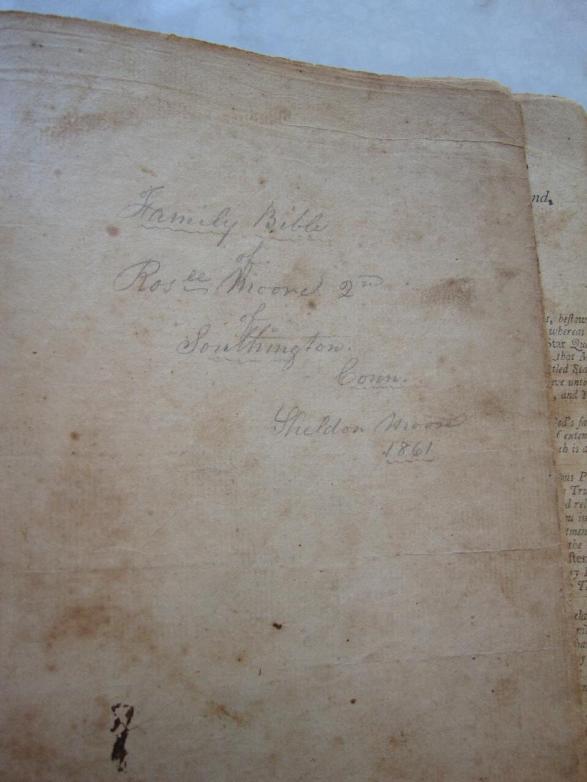
Inscription in the Family Bible.
The bible is from 1791, and assuming that Roswell Moore had bought it that same year, then he would have been 30 years old, married for 4 years and had two children, John and Dimmis. The inscription reads, “Family Bible of Ros’ll Moore 2nd of Southington, Conn. Sheldon Moore 1861”.
Eliza tells me the bible is in bad shape. The back cover has fallen off and if it ever contained any precious family information, then those pages are missing.
This is not the Family Bible of Roswell Moore that is mentioned in Ethelbert Allen Moore’s book, Tenth Generation. E. A. Moore was the grandson of Sheldon’s brother, Roswell Moore, Jr (1793-1857).That bible belonged to the first Roswell Moore (1728-1794) and did contain family information, as recorded by Sheldon Moore in 1810. I don’t know if that bible is still in existence. But if it is, my guess would be that one of the descendants of Roswell, Jr. has it. They seem to have all the good stuff.
Still, Eliza’s bible is a priceless, family heirloom and I’m thankful that she shared the pictures with me.
Possunt quia posse videntur (They can because they think they can) -Virgil
In an application for a United States passport I’ve found a physical description of Sheldon Moore. Written in his own hand, he describes himself as being 5’11” (rather tall for his time), dark grey eyes, light complexion, with a thin, slender face, his mouth and chin were slightly disfigured from a childhood burn. For some reason, maybe because he had been a teacher, I often imagine him looking like Ichabod Crane from The Legend of Sleepy Hollow.
“The Legend of Sleepy Hollow by Washington Irving (1875)
Sheldon battled health issues his whole life and was often sick. As a boy he probably wasn’t healthy enough to play outside with the other children and this may explain why he was an avid reader and lover of literature. Among his siblings he emerged as the intellectual one of the family. Sheldon was the only one of Roswell Moore’s 12 children that received a college education. Roswell paid Sheldon’s tuition at Yale University and may have chosen his course of study, Law. Roswell, or “Squire” Moore as he was known in Southington was a State Legislator in the Connecticut House of Representatives from 1807-1821 and a Justice of the Peace. So it’s quite possible that Squire Moore desired to have an actual lawyer in the family.
Sheldon attended Yale with his friend Romeo Lowrey, who was also from Southington and also studying law. Both young men graduated Phi Beta Kappa in 1818. Yale President, Jerimiah Day personally recommended Romeo Lowrey for a position near Winchester, Virginia as a tutor for a family. Sheldon took a job as a teacher near Vansville, Maryland just outside Washington D.C.
Catalogue of the Connecticut Alpha of the Phi Beta Kappa, Yale College, 1852
These were exciting times, not just for Sheldon and Romeo, but for other friends from Southington. Truman Dunham (Sheldon’s second cousin) was in Cincinnati, Ohio and Augustus Goodsell was in Charleston, South Carolina. In letters written at the time, the men kept track of each other’s movements and welfare.
Sheldon visited Washington at least a couple of times while living in Maryland. But at that time, it had only been four years since the British had torched the city during the War of 1812, so the city may not have been much to look at. Sheldon became fascinated with the Congress and his father commented in a letter, that Sheldon had written more about the Congress then what was happening in his own life.
U.S Capitol After Burning by the British (1814) by George Munger
In January, 1819 Sheldon wrote to Augustus Goodsell that all was going well with the school and he was enjoying good health. However, a month later he wrote his father complaining that he had been quite ill and had been missing school. The details of his illness take up a page and a half of the four page letter, and contains a heads up that if he didn’t feel better soon he would be closing the school and returning home in a few weeks.
He had only planned to stay a year in Maryland and then return to Connecticut, so it’s unclear if the illness drove him home early or he came home when his time in Maryland was up. But in March of 1820 he was back in Southington and apparently unemployed. Romeo Lowrey, who had returned from Virginia after being away a year, was now working in the office of Judge Ansel Sterling in Sharon, Connecticut (Sterling was elected to Congress the following year and served in the House of Representatives until 1825). Romeo wrote Sheldon and told him he had recommended him to Reverend David L. Perry, who ran the Sharon Academy and was looking for a teacher. The pay wasn’t good but the Academy had plenty of books. Sheldon took the job.
Again Sheldon only planned on staying at this teaching job for one year. But by July of 1820 he was complaining about low wages and was already looking to return home. Roswell Moore was now very dissatisfied with his son, partly because the expense of Sheldon’s education had still not been repaid. Sheldon’s brother, Oliver wrote him a letter in which he, as delicately as possible, tried to explain their father’s position, while remaining supportive of his brother’s decision. Oliver also echoed the sentiments of Romeo Lowrey four months earlier, reminding Sheldon that making some money was better than making none and quoted Proverbs 10:4 to prove his point (He becometh poor that dealeth a slack hand: but the hand of the diligent maketh rich). It’s unclear if Oliver’s words swayed Sheldon and he completed his year at the Sharon Academy.
Connecticut Common School Journal, Vols. 1-4 (1842)
In the years to come Sheldon would try his hand at other professions besides teaching. Though he did continue to teach on the side. As early as 1831 he was teaching Sunday School in Kensington. From 1832-1834 he was the Sunday School Superintendent for Berlin. He held this position again from 1836-1840. In 1842, he was on a committee, along with Reverend Royal Robbins, to improve the schools in Berlin. The committee made Emma Willard Superintendent of Schools in Berlin. Mrs. Willard had recently retired from the Troy Seminary School in Troy, New York, which she had founded.
Romeo Lowrey passed the Bar in 1820 and returned to Southington where he started a law practice. He was later Justice of the Peace, an Assistant Judge and represented Southington in the Connecticut House of Representatives and the State Senate. He died in Southington on January 30, 1856 and is buried in Oak Hill Cemetery, not far from Roswell Moore.
Sources:
U.S. Passport Applications, 1795-1925, Ancestry.com
Autobiography of Nelson Augustus Moore of Kensington, Connecticut
Sheldon Moore Papers Yale University Manuscript (MS 992)
Ecclesiastical and Other Sketches of Southington, Connecticut by Heman R. Timlow (1875)
Two Hundredth Anniversary, Kensington Congregational Church (1912)
Connecticut Common School Journal, Vols. 1-4 (1842)
Picture Credit:
U.S. Capitol after burning by the British (1814) by George Munger, Library of Congress Prints and Photographs Division, Reproduction number LC-DIG-ppmsca-23076 (Digital file from original item)
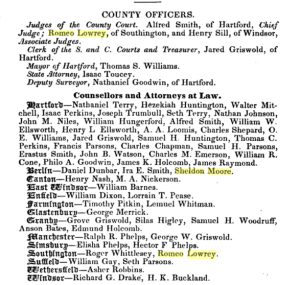
The New England and New York Law Register for the Year 1835Romeo Lowrey, Oak Hill Cemetery
“The Double Bridge. Old Cement Mill in Distance” Courtesy of the Berlin Historical Society. Used by permission.
In 1925, 21 year old Idabelle Lindsley of Kensington photographed a sign near Steel Shop Pond on the Mattabassett River that read, “CEMENT MILL, Site of first cement mill in United States, 1829”. This is a rather bold and entirely untrue statement. The sign should have read, “Site of the first blue limestone, hydraulic cement mill in Connecticut, 1826”. Though even this statement is debatable.
Fact: A cement mill owned by Roswell Moore of Southington and operated by his sons, Roswell, Jr. and Oliver did exist in Kensington from at least 1826 until the 1850’s under the name R. Moore & Sons.
Fact: Hydraulic or water cement was being manufactured in New York near the Erie Canal as early as 1818.
In 1801, Roswell Moore had bought Solomon Winchell’s half of a grist and carding mill that Winchell co-owned with Dr. James Percival (father of poet James G.), and by 1817, Roswell owned the mill entirely, following the sudden death of Dr. Percival. This mill, between High Road and Glen Street, just west of the Congregational Church, was also used in the production of linseed oil. Later a saw mill was added. Just to the south another mill was built for manufacturing kiln dried meal, and it was this mill that was eventually converted into the cement mill. These mills collectively were known as “Moore’s Mills”.
But the story of the cement mill begins in Southington with Sheldon Moore and his friends, Gad Andrews (son of Luman Andrews) and Anson Merriman.
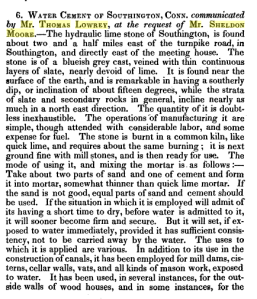
Excerpt from the American Journal of Science and the Arts, Vol. 13 (1828)
The Luman Andrews homestead and farm was at the corner of what is now Andrews and Woodruff Streets, not far from the Berlin line. Almost a mile north was Roswell Moore’s property and between them was Anson Merriman’s home.
Sheldon Moore had graduated from Yale in 1818 with a law degree and had worked as a teacher in Vansville, Maryland and Sharon, Connecticut. He shared a mutual interest in science with his friends Andrews and Merriman and subscribed to the American Journal of Science and the Arts, which was published by his old college professor, Benjamin Silliman. In 1825, the three men had read an article in the journal about limestone being used to make cement for the Erie Canal. In the early 1800’s the young country was very much in need of a water limestone or hydraulic cement that would harden in water to be used to construct canals, dams and bridges. Merriman remembered seeing an outcrop of a blue limestone on the Andrews property and wondered if it might be used to make cement.
Sheldon then wrote Professor Silliman asking him if this blue limestone might have the necessary properties to make hydraulic cement, when Silliman didn’t respond immediately, an anxious Anson Merriman wrote several more letters. Professor Silliman’s response to Sheldon was simple, an experiment was needed using the blue limestone. The rock would need to be burnt, then pulverized, mixed with sand and left in water to see if it would set. The experiment was a success and plans were made to begin manufacturing.
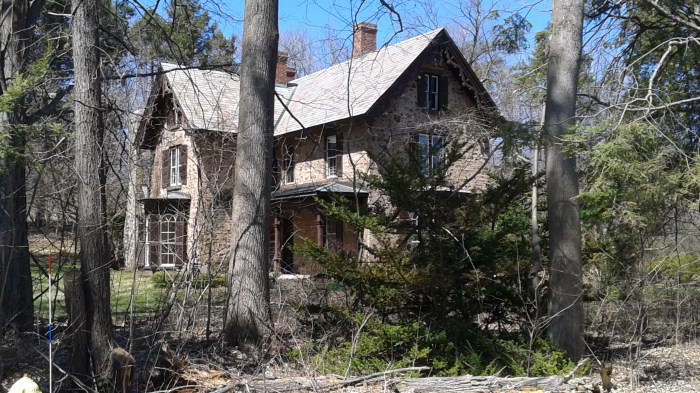
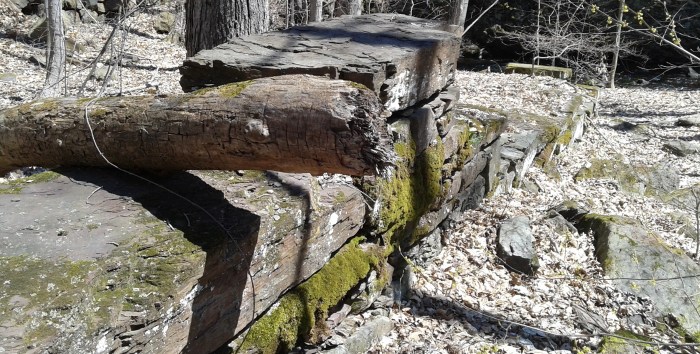
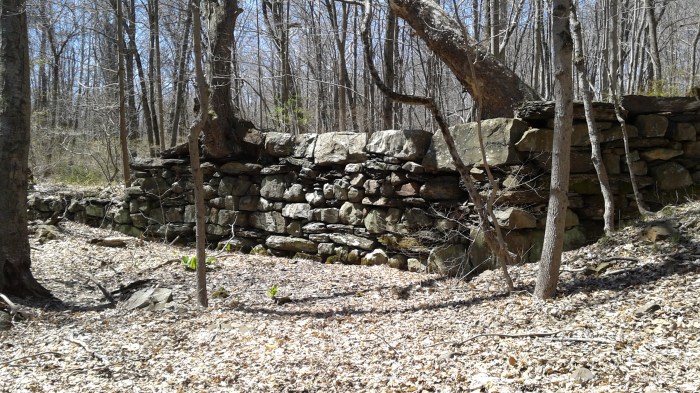
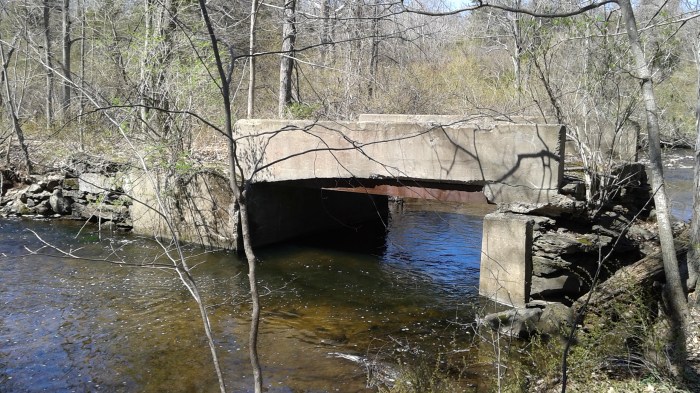
Remnants of one of the Moore’s mills in Kensington on the Mattabassett River
But soon after the blue limestone was also discovered on the Moore property. It is here that the Moore and Andrews firms appear to have parted ways. Roswell Moore seems to have been a shrewd businessman. So why would he want to share the profits of this new enterprise with Luman Andrews? After all, he possessed his own supply of blue limestone, and the kilns that were needed to burn it were already being constructed just south of the Moore home. Plus, he had something that Andrews didn’t; a working mill that would be needed to grind the limestone.
Not only did Luman Andrews not have a mill, he didn’t even possess the water power necessary to power one. This was remedied in July of 1829 when they leased and later purchased land from Seth Cowles of Berlin, on what is now Carey Street in Southington, where they constructed a dam and mill.
The Moore’s also had all the key people needed to run a successful cement business. Younger brother Eli Moore handled things on the Southington side, which included quarrying the blue limestone and burning it in the kilns. The quarry being located across the road from the Moore homestead where the Wassel Reservoir is now. The limestone was then transported 3 1/2 miles away, via Carey Street between the two Hart ponds, to the mill in Kensington. Here, Roswell, Jr., an expert miller, ground the limestone. It was then put into barrels and brought to Middletown where it was shipped to agents and suppliers who sold it to customers as far away as the West Indies. Oliver Moore, the engineer of the family, was in charge of building dams, mills, and probably the kilns. Sheldon Moore acted as comptroller, accountant and handled legal affairs. And Roswell Moore was the owner and CEO, who not only used his business skills to find suppliers and customers, but also handled advertising.
Wassel Reservoir, across from Roswell Moore’s house in Southington, Connecticut. Site of the Moore’s quarry.
On a personal level, this venture was exactly what Sheldon needed to redeem himself with his father. Roswell Moore, who had paid Sheldon’s tuition at Yale, had viewed his son’s education as a kind of investment. An investment that up to this point, that had not paid off. The cement business became R. Moore & Sons most profitable enterprises.
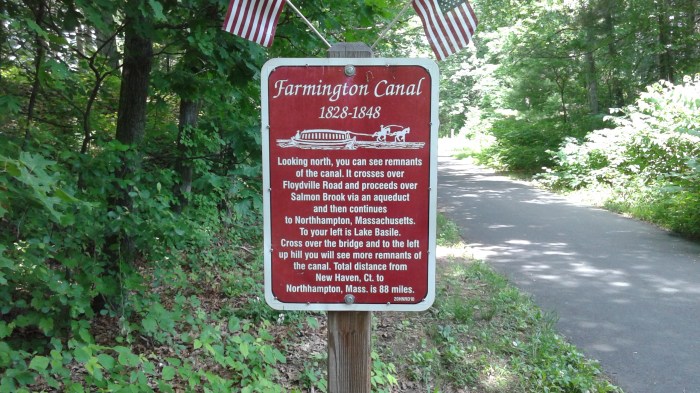
One of the first customers, of what was still Moore & Andrews, was the Farmington Canal Company. The Farmington Canal operated from 1828-1848 and ran from Northampton, Massachusetts to New Haven, Connecticut. Cement from Southington was used to build bridges, locks, piers, abutments and culverts and a stone dam that crossed the Farmington River. Farmington Canal Company began purchasing cement from Moore & Andrews as early as 1826. The canal became obsolete with the coming of the railroad, which in many sections, ran adjacent to the canal. Today the railroad is also gone and has been replaced by the Farmington Rail Trail, a bike path.
Sign on the Farmington Rail Trail in Simsbury, Connecticut
By 1828, there was another competitor from Southington in the cement business, the firm of Barnes & Bradley which was operated by Liva Barnes and Jason Bradley. Their quarry was located south of the Andrews homestead and they built their mill on the property of David Sloper. The new competition drove the price of cement down, but in spite of this, the Moore’s cement business continued to turn a profit for the next three decades.
However, what was once considered an inexhaustible supply of blue limestone in Southington was beginning to dwindle by the early 1850’s. Barnes & Bradley had already run out and the Moore and Andrews firms were running low. Roswell Moore and Luman Andrews were now dead and what was left of the cement businesses was being run by Eli Moore and Bennett J. Andrews (son of Luman), who resurrected the original firm of Moore & Andrews.
By the late 1850’s the manufacturing of cement by Moore & Andrews had ceased completely. A few years prior, Roswell, Jr. retired from milling and became deacon of the Congregational Church in Kensington. Oliver Moore converted the cement mill into a shop that manufactured steelyards and gardening tools. And Gad Andrews had also retired, turning his attention to genealogy.
The next generation of Moore’s and Andrews’ both tried to take credit for being the first to manufacture hydraulic cement. In his unpublished autobiography, Nelson Augustus Moore (son of Roswell, Jr.) claimed that R. Moore & Sons had been the first to successfully market hydraulic cement and that Anson Merriman’s attempts to market the cement had failed. In his book, Ecclesiastical and Other Sketches of Southington, Connecticut published in 1875, Heman R. Timlow also claimed that Gad Andrews and Merriman’s cement business had actually failed. Although Anson Merrimans role in the cement industry is unknown it’s certainly not true that the Andrews firm had failed.
In 1924, Frank D. Andrews (son of Bennett J.) wrote a privately published and incredibly informative book called, History of the Discovery of Water-Limestone and Early Manufacture of Cement at Southington, Connecticut in which he doesn’t claim, but certainly implies that the Andrews family were the first in the State to manufacture cement.
In his aforementioned autobiography, N. A. Moore vividly describes the mills in Kensington, including the trees and foliage surrounding the streams and ponds near the mills and the day to day operation of the mills. Moore also sketched and painted several pictures of the mills in Kensington. Around 1865, he briefly reopened the cement mill in order to produce enough cement to build his house on High Road, next door to his father’s home, that he called “Stonehouse”.
Nelson Augustus Moore’s “Stonehouse” in Kensington, Connecticut
Sources:
Early Cement Manufacture in Connecticut by Clarence N. Wiley, presented at the 49th Annual Meeting of the Connecticut Society of Civil Engineers, Hartford, Connecticut, Feb. 22, 1933
History of New Britain with Sketches of Farmington and Berlin by David N. Camp (1889)
History of the Discovery of Water-Limestone and Early Manufacture of Cement at Southington, Connecticut by Frank D. Andrews (1924)
Autobiography of Nelson Augustus Moore of Kensington, Connecticut
Sheldon Moore Papers Yale University Manuscript (MS 992)
Connecticut Mill Sign, Berlin photographed by Idabelle Lindsley Tatro (1925) Connecticut Historical Society Object Number 1977.92.297
Beneath a broad crowned oak, on a sloping hill o’erlooking wide the lovely region round. On a soft thick turf I lay; the air was still- distinctly heard was each remotest sound. The clacking wheel in a cornfield, at the mill the circling ‘plash, and far the faint rebound of low and bleat from mountain side, the stir of insect swarms, the drone bee’s hum and swirr. -James Gates Percival “The Dream of a Day”
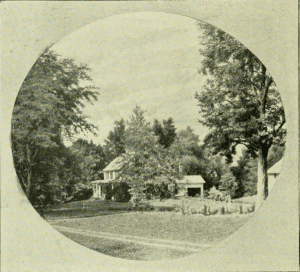
This house was originally built by Mathew Hart in 1759. Hart served during the Revolutionary War as a Private in Captain Selah Hart’s Company, Colonel Wolcott’s Regiment, and later as a Corporal in Captain James Stoddard’s Company, Colonel Moseley’s Regiment. He further contributed to the war effort by producing bullets for the Continental Army made from the lead from the nearby mine. He was also the maternal grandfather of the poet, James Gates Percival.
Circa 1900
Around 1800, Hart removed to De Ruyter, New York and the house was sold to Norman Winchell. In 1813, Winchell sold it to Oswin Percival (brother of James G). And in 1824, Percival sold it to Sheldon Moore’s father, Roswell.
Sheldon’s brothers, Oliver and Roswell, Jr. and their respective families shared the house from 1824, until Roswell, Jr. built his own home on nearby High Road and Oliver temporarily left Kensington, going first to West Springfield, Massachusetts, and later Miller’s Falls, a section of the towns of Erving and Montague originally known as Grout’s Corner. Oliver’s daughter, Nancy, and Roswell’s son, Nelson Augustus (the artist), were both born in this house on August 2, 1824.
On August 13, 1831, Sheldon Moore wrote his fiancee’, Susan L. Dickinson and told her that his brother Oliver was moving to Massachusetts and leaving the house to them. They occupied the house until Sheldon’s death in 1866.
After Sheldon’s death, Susan L. Moore lived with her children until her own death in 1897.
From at least 1900-1939 the house was owned by Oliver Moore’s granddaughter, Alice and her husband Isaac Porter.
Sources:
“Tenth Generation” by Ethelbert Allen Moore (1950)
“Autobiography of Nelson Augustus Moore of Kensington, Connecticut” (Unpublished)
“Sheldon Moore Papers” Yale University Manuscript (MS 992)
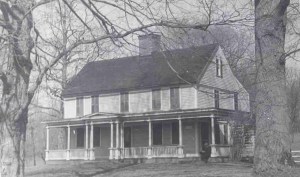
“Sheldon Moore Place” Photograph by Nelson Augustus Moore, Connecticut Historical Society Object 2006.65.2. Inscription: ‘Sheldon Moore Place. Where I was born and in the same day Nancy Moore (my cousin) daughter of Oliver Moore she died at Millers Falls Mass aged 15 years and was buried in West Lane Burying Ground-N.A.M.’
Picture Sources:
“Mathew Hart Place” The Connecticut Magazine, Volume 6 (1900) Illustration by Isaac Porter
“Berlin Historical Building 024” WPA Architectural Survey 1935-1942, from the Connecticut State Library Digital Archives
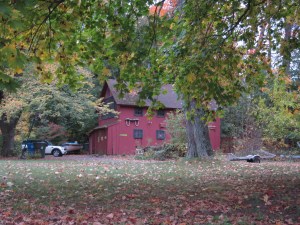
“Sheldon Moore’s Home in Kensington” and “The small barn on the property” by spellmanjr October 31, 2014









 Sheldon Moore