Recently I was contacted on ancestry.com by my third cousin, I’ll call her “Eliza”, about a Family Bible that had belonged to Sheldon Moore’s father, Roswell Moore II (1761-1847) or “Squire Moore” as he was sometimes known. Eliza wanted to know if I would be interested in seeing pictures of the bible which included an inscription by Sheldon Moore. I couldn’t have replied, “Yes!” any faster.
Eliza explained that the bible had been handed down to her by her father, who apparently had got it from his mother, who was a Moore. Eliza’s grandmother must have gotten it from her father, who got it from his father, who was Sheldon Moore’s son, Charles Moore of Southington, Connecticut, who is me and Eliza’s mutual great-great grandfather.
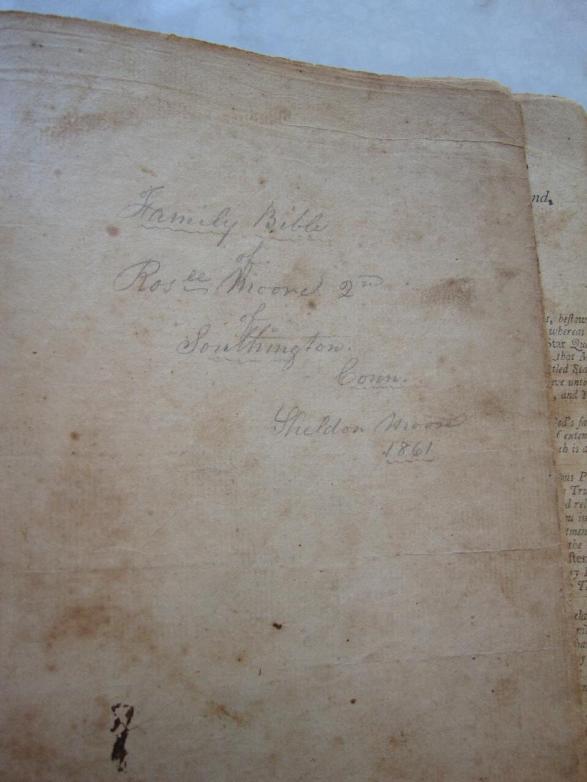
Inscription in the Family Bible.
The bible is from 1791, and assuming that Roswell Moore had bought it that same year, then he would have been 30 years old, married for 4 years and had two children, John and Dimmis. The inscription reads, “Family Bible of Ros’ll Moore 2nd of Southington, Conn. Sheldon Moore 1861”.
Eliza tells me the bible is in bad shape. The back cover has fallen off and if it ever contained any precious family information, then those pages are missing.
This is not the Family Bible of Roswell Moore that is mentioned in Ethelbert Allen Moore’s book, Tenth Generation. E. A. Moore was the grandson of Sheldon’s brother, Roswell Moore, Jr (1793-1857).That bible belonged to the first Roswell Moore (1728-1794) and did contain family information, as recorded by Sheldon Moore in 1810. I don’t know if that bible is still in existence. But if it is, my guess would be that one of the descendants of Roswell, Jr. has it. They seem to have all the good stuff.
Still, Eliza’s bible is a priceless, family heirloom and I’m thankful that she shared the pictures with me.
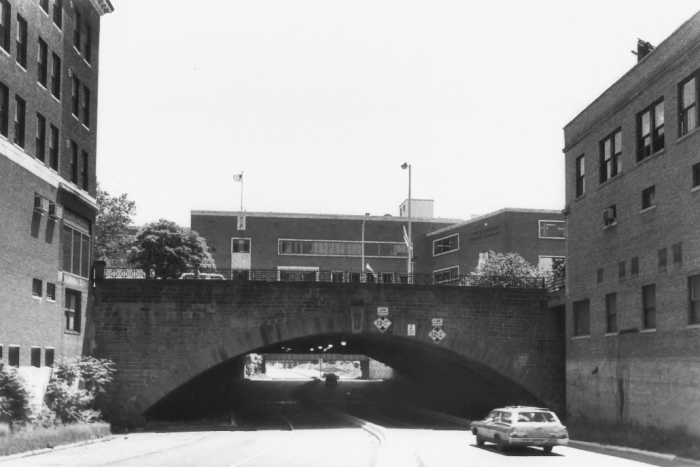
Stone Bridge in Hartford, Connecticut. National Register of Historic Places Digital Archive (1985).
Anyone taking the Capitol Avenue exit from Interstate 91 (Exit 29A) in Hartford, Connecticut will find themselves on the Whitehead Highway. After passing under the Hartford Public Library, but before reaching Pulaski Circle, they will pass under a very old stone bridge. The bridge was built in 1833 and is listed on the National Register of Historic Places. The structure was the largest single arch bridge in the United States at the time it was constructed along Main Street, and it spanned the Park River (or Mill River, as it was known then).
On the last page of Frank D. Andrews’ book, History of the Discovery of Water-Limestone and Early Manufacture of Cement at Southington, Connecticut, Andrews says that the mortar used on the Main Street Bridge over the Park River was “Andrews cement” that was manufactured in Southington. He cites George W. Bartholomew as his source. The actual name of the company was L & G Andrews. The “L” being Luman and the “G” being Gad, father and son respectively.
Originally, the citizens of Hartford were wary of the new bridge and would tie their horses and walk over the bridge out of fear of collapse. But the bridge, which has been in constant use since, has withstood the test of time and the floods that plagued the Park River.
Main Street Bridge over the Park River. Illustration from the Memorial History of Hartford County, Connecticut 1633-1884 (1886)
It’s even outlived the river that it once spanned. In 1940, the city of Hartford started planning the Park River conduit project, which essentially buried the river so that a highway could be built over it. Three of the four bridges over the river were scheduled to be reconstructed. The only surviving bridge was the stone bridge on Main Street. The project began in 1941 and was completed around 1943. An article that appeared in the Hartford Courant in 1942 described proponents and opponents of the project, lining the Main Street Bridge and watching steam shovels struggle mightily to remove heavy shale rock that lined the river bed.
When it was built 185 years ago, the Springfield Republican called the new stone bridge, “an imposing piece of masonry, which will endure for ages”. They were absolutely right. And it’s all held together by cement that was produced in Southington by L & G Andrews.
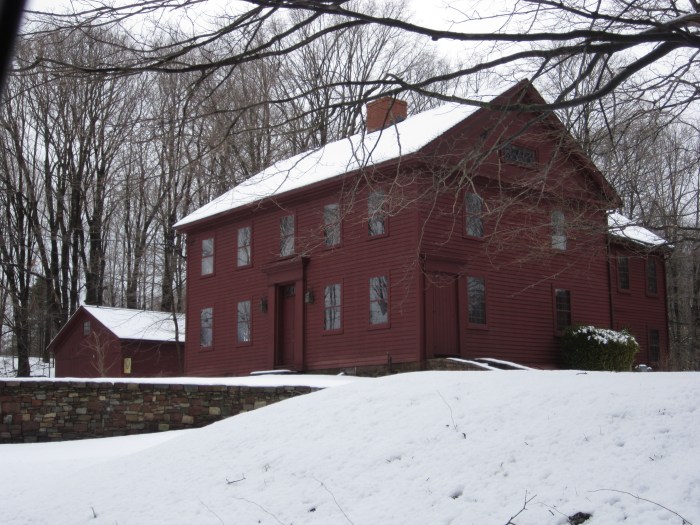
Luman Andrews’ House, Southington, Connecticut. Site of Andrews’ Cement quarry and kilns.
Sources:
Memorial History of Hartford County, Connecticut 1633-1884 (1886), Chapter 2, Section 1, “The Town Since 1784” by Miss Mary K. Talcott, page 369.
History of the Discovery of Water-Limestone and Early Manufacture of Cement at Southington, Connecticut by Frank D. Andrews (1924).
Various newspaper articles from the Hartford Courant found on newspapers.com.
______________________________________________
Hutton’s Mathematics Math Book that belonged to Sheldon Moore.
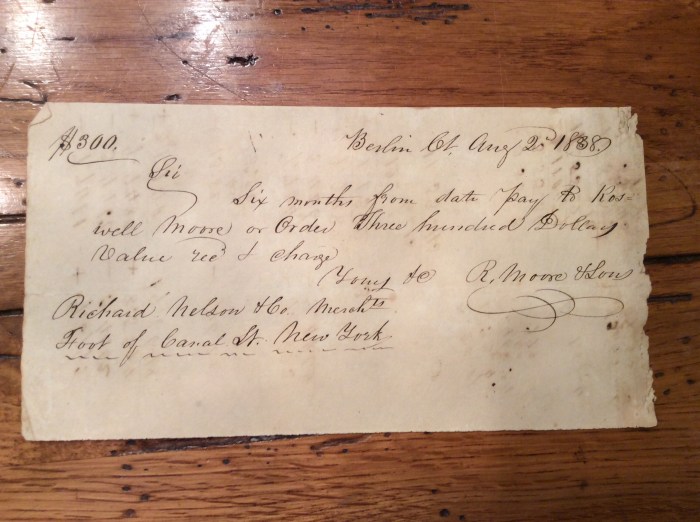
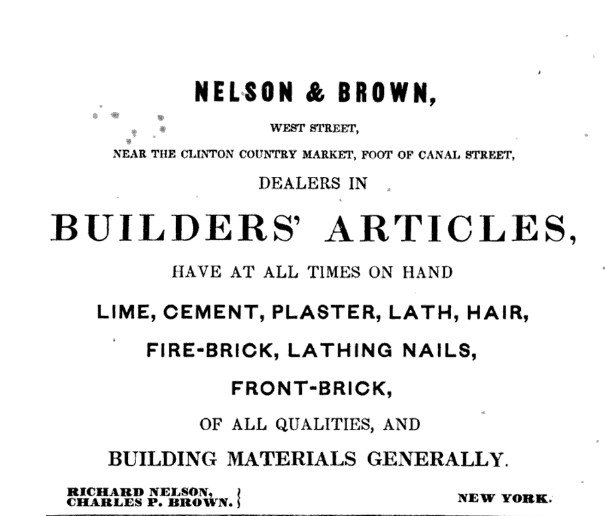
In 2017, a Hutton’s Mathematics Math Book came into my possession. The book had once belonged to Sheldon Moore, and he had bought it in 1816 when he was attending Yale College. Inside the book were a few pieces of paper that had been written on by Sheldon, including a bill for cement from R. Moore & Sons to Richard Nelson of New York City. Richard Nelson was the co-owner of Nelson & Brown and a supplier of cement.
Bill for Water Cement (1838)Advertisement from the New York City Directory (1842)
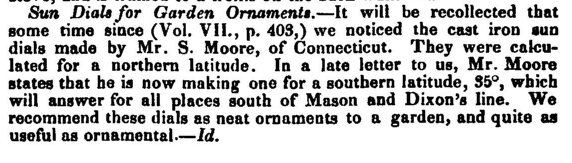
Recently I was lucky enough to purchase a sundial that was manufactured by Sheldon Moore around 1840. The cast iron sundial is almost 10 inches in diameter and the gnomon stands nearly 5 inches high. It will keep perfect time from as far north as Montpelier, Vermont and as far south as Washington D.C.
I found it online at Delaney Antique Clocks (delaneyantiqueclocks.com) which is located in West Townsend, Massachusetts. One of the store’s owners, John Delaney has been featured many times on PBS’s Antique Road Show. Imagine my surprise when I googled “sundial manufactured by S. Moore Kensington, CT”, and as it turned out there was one for sale. I quickly emailed John Delaney and asked for a price. He replied that it was $150. I considered haggling with him but thought better of it and paid the full asking price plus shipping. Did I pay too much? Maybe, but this was a rare opportunity to have a treasured family artifact. Truth is I probably would have paid more.
New Genesee Farmer, Vol. 3 No. 6, pg. 88
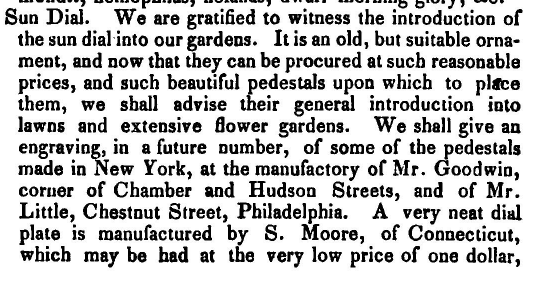
This is not the first time I’ve seen a Sheldon Moore sundial. In October, 2014 I was able to see one at the Connecticut Historical Society in Hartford. That sundial, which is blueish in color and not pictured here, was donated to the Historical Society by the Moore family in 1947 (I’m not sure by which Moore’s). An article published in the Connecticut Historical Society Bulletin in October, 1947 describes Sheldon Moore’s sundial business, which is believed to have existed between 1840 to 1841 and was abandoned due to a small profit margin. I did however, find an article published in the New Genesee Farmer dated June, 1842. The 1947 Bulletin article was reprinted in December, 2008 in The Compendium, a quarterly journal published by the North American Sundial Society. The article goes into great detail about the cost of manufacturing the sundials, and in a nutshell, it cost .50 cents to make one and each sold for a dollar. Now, given inflation over the last 170 years, I think I got a pretty good deal.
The Magazine of Horticulture, Botany, and All Useful Discoveries and Improvements in Rural Affairs, Vol. VII, pg. 403Vol. VIII, pg. 312
If you would like to read The Compendium article, it can be found online at http://sundials.org/index.php/dial-resources.
________________________
Last summer I bought a first edition Poems by James G. Percival, which I found online on eBay. I think I paid $50 for it. Since discovering that Sheldon Moore was a close, lifelong friend of Percival I’ve become somewhat fascinated by this strange, eccentric man. I’ve done a lot of research on him and even read some of his poetry. I’ve never been much of a poetry reader so I have nothing to compare it to, but I really like his writings. My favorites are Prometheus I and II and The Dream of a Day. Percival was very popular in his day but his work hasn’t stood the test of time and today his books are hard to find. That being said, the book I bought is in rough shape and the back cover is literally hanging by a string, and it probably isn’t worth the $50 I paid for it. But, as I discovered, this little book had it’s own story to tell.
Written on the first page is, “John G. Locke 1826”. In the back of the book this same John G. Locke wrote, “May 25th 1826. Heading for the Mona Passage on the James Coulter -J.G.L.” Some research by yours truly turned up some interesting information.
John Goodwin Locke was born in Ashby, Massachusetts on April 1, 1803 and died in Boston on July 22, 1869. On October 25, 1829 he married Jane Ermina Starkweather of Worthington, Massachusetts. Mrs. Locke was a poet herself and her most popular work was Boston: A Poem published in 1842. In later years, John G. Locke was a lawyer but early on he was in the mercantile business and in 1826 he went to Caracas, Venezuela as an agent for a New York commercial house. It’s said that he returned the same year because business was unprofitable. But his return may have had more to do with regional uprisings throughout Venezuela. Newspaper articles from the time reported that the brig James Coulter had arrived in New York on May 28, 1826 and had brought news from Venezuela about the revolution brewing in that country. John G. Locke appears with five other merchants on the James Coulter’s manifest when it arrived in Falmouth, Massachusetts from Venezuela in June, 1826.
From “The Book of Lockes”
But what I personally found most fascinating about John G. Locke was that he was a genealogist. In 1853 he published two books, The Book of Lockes and The Munroe Genealogy. He was also a member of the New England Historical Society.
In the beginning of Percival’s book of poems he quoted Robert Southey, “Go little book, from this my solitude, I cast thee on the waters-go thy ways. And if, as I believe, thy vein be good, the world will find thee after certain days”. I know my little book traveled on the waters, in late May, 1826. It left Venezuela and sailed the strait between Hispaniola and Puerto Rico known as the Mona Passage on the James Coulter on route to New York and ultimately Falmouth. In 2015 it somehow found it’s way to me in Connecticut, and just days after receiving it I brought it with me to Kensington when I photographed Percival’s home where much of the book was written in 1820. Thus completing the little book’s journey.
Sources:
ancestry.com
wikipedia.org
The New England Historical and Genealogical Register and Antiquarian Journal, Vol. 25, pg. 92 (1871)
Possunt quia posse videntur (They can because they think they can) -Virgil
In an application for a United States passport I’ve found a physical description of Sheldon Moore. Written in his own hand, he describes himself as being 5’11” (rather tall for his time), dark grey eyes, light complexion, with a thin, slender face, his mouth and chin were slightly disfigured from a childhood burn. For some reason, maybe because he had been a teacher, I often imagine him looking like Ichabod Crane from The Legend of Sleepy Hollow.
“The Legend of Sleepy Hollow by Washington Irving (1875)
Sheldon battled health issues his whole life and was often sick. As a boy he probably wasn’t healthy enough to play outside with the other children and this may explain why he was an avid reader and lover of literature. Among his siblings he emerged as the intellectual one of the family. Sheldon was the only one of Roswell Moore’s 12 children that received a college education. Roswell paid Sheldon’s tuition at Yale University and may have chosen his course of study, Law. Roswell, or “Squire” Moore as he was known in Southington was a State Legislator in the Connecticut House of Representatives from 1807-1821 and a Justice of the Peace. So it’s quite possible that Squire Moore desired to have an actual lawyer in the family.
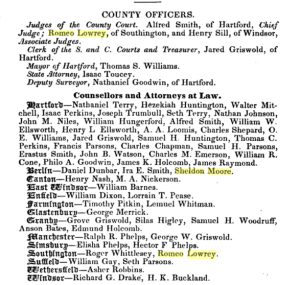
Sheldon attended Yale with his friend Romeo Lowrey, who was also from Southington and also studying law. Both young men graduated Phi Beta Kappa in 1818. Yale President, Jerimiah Day personally recommended Romeo Lowrey for a position near Winchester, Virginia as a tutor for a family. Sheldon took a job as a teacher near Vansville, Maryland just outside Washington D.C.
Catalogue of the Connecticut Alpha of the Phi Beta Kappa, Yale College, 1852
These were exciting times, not just for Sheldon and Romeo, but for other friends from Southington. Truman Dunham (Sheldon’s second cousin) was in Cincinnati, Ohio and Augustus Goodsell was in Charleston, South Carolina. In letters written at the time, the men kept track of each other’s movements and welfare.
Sheldon visited Washington at least a couple of times while living in Maryland. But at that time, it had only been four years since the British had torched the city during the War of 1812, so the city may not have been much to look at. Sheldon became fascinated with the Congress and his father commented in a letter, that Sheldon had written more about the Congress then what was happening in his own life.
U.S Capitol After Burning by the British (1814) by George Munger
In January, 1819 Sheldon wrote to Augustus Goodsell that all was going well with the school and he was enjoying good health. However, a month later he wrote his father complaining that he had been quite ill and had been missing school. The details of his illness take up a page and a half of the four page letter, and contains a heads up that if he didn’t feel better soon he would be closing the school and returning home in a few weeks.
He had only planned to stay a year in Maryland and then return to Connecticut, so it’s unclear if the illness drove him home early or he came home when his time in Maryland was up. But in March of 1820 he was back in Southington and apparently unemployed. Romeo Lowrey, who had returned from Virginia after being away a year, was now working in the office of Judge Ansel Sterling in Sharon, Connecticut (Sterling was elected to Congress the following year and served in the House of Representatives until 1825). Romeo wrote Sheldon and told him he had recommended him to Reverend David L. Perry, who ran the Sharon Academy and was looking for a teacher. The pay wasn’t good but the Academy had plenty of books. Sheldon took the job.
Again Sheldon only planned on staying at this teaching job for one year. But by July of 1820 he was complaining about low wages and was already looking to return home. Roswell Moore was now very dissatisfied with his son, partly because the expense of Sheldon’s education had still not been repaid. Sheldon’s brother, Oliver wrote him a letter in which he, as delicately as possible, tried to explain their father’s position, while remaining supportive of his brother’s decision. Oliver also echoed the sentiments of Romeo Lowrey four months earlier, reminding Sheldon that making some money was better than making none and quoted Proverbs 10:4 to prove his point (He becometh poor that dealeth a slack hand: but the hand of the diligent maketh rich). It’s unclear if Oliver’s words swayed Sheldon and he completed his year at the Sharon Academy.
Connecticut Common School Journal, Vols. 1-4 (1842)
In the years to come Sheldon would try his hand at other professions besides teaching. Though he did continue to teach on the side. As early as 1831 he was teaching Sunday School in Kensington. From 1832-1834 he was the Sunday School Superintendent for Berlin. He held this position again from 1836-1840. In 1842, he was on a committee, along with Reverend Royal Robbins, to improve the schools in Berlin. The committee made Emma Willard Superintendent of Schools in Berlin. Mrs. Willard had recently retired from the Troy Seminary School in Troy, New York, which she had founded.
Romeo Lowrey passed the Bar in 1820 and returned to Southington where he started a law practice. He was later Justice of the Peace, an Assistant Judge and represented Southington in the Connecticut House of Representatives and the State Senate. He died in Southington on January 30, 1856 and is buried in Oak Hill Cemetery, not far from Roswell Moore.
Sources:
U.S. Passport Applications, 1795-1925, Ancestry.com
Autobiography of Nelson Augustus Moore of Kensington, Connecticut
Sheldon Moore Papers Yale University Manuscript (MS 992)
Ecclesiastical and Other Sketches of Southington, Connecticut by Heman R. Timlow (1875)
Two Hundredth Anniversary, Kensington Congregational Church (1912)
Connecticut Common School Journal, Vols. 1-4 (1842)
Picture Credit:
U.S. Capitol after burning by the British (1814) by George Munger, Library of Congress Prints and Photographs Division, Reproduction number LC-DIG-ppmsca-23076 (Digital file from original item)
The New England and New York Law Register for the Year 1835Romeo Lowrey, Oak Hill Cemetery
Susan L. Wife of Sheldon Moore, died Mar. 20, 1897, age 87 yrs.
Susan Langdon Dickinson was born in Kensington on November 20, 1809. She was the daughter of Jesse and Chloe (Allen) Dickinson and was named after her grandmother, Susannah (Langdon) Hooker Dickinson.
Susan’s roots in Kensington ran very deep and she is seemingly related to everyone in the area either by blood or marriage, including Sheldon’s brother in law, Charles C. Langdon, the husband of Sheldon’s sister, Eliza. Susan and Charles Langdon were distant cousins who had a mutual 3rd great grandfather, John Langdon. Susan also shared a mutual uncle and aunt with the poet, James G. Percival. Percival’s uncle being Matthew Hart, Jr. and Susan’s aunt being Urania (Hooker) Hart.
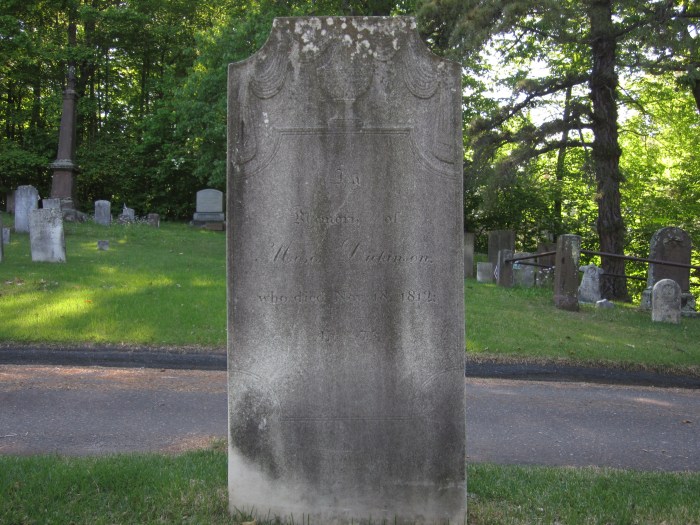
Susan’s grandfather, Moses Dickinson was born in Wethersfield but had come to Kensington before 1760. That being the year he married Lydia Cole. He owned land along, what is today, High Road and Four Rod Road. It is said that he donated the land for West Lane Cemetery and that he was the first person buried there. He died in Kensington on November 18, 1812.
In Memory of Moses Dickinson, who died Nov. 18, 1812: Age 75 yrs.
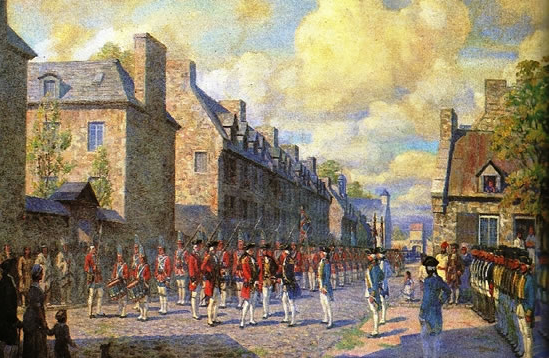
Moses fought in the French and Indian War from 1759-1760 and was enlisted in General Phineas Lyman’s 1st Connecticut Regiment, Captain Whittlesey’s Company. Also serving in this regiment and company was Kensington native, Ashbel Hooker. Hooker had enlisted as a clerk in 1758 and was later promoted to a sergeant and then to ensign. He married Susannah Langdon in Berlin on January 31, 1760 and then returned to duty. Their daughter Urania was born May 11, 1760 (these dates probably mean that Susannah was already with child before they married). Ashbel Hooker died September 6, 1760 in Canada two days before the French surrendered Montreal to British forces. It is very likely he never met his daughter.
Surrender of Montreal, September 8, 1760
Moses and Lydia’s first and only child, Seth was born February 7, 1762 and it’s possible that Lydia died during childbirth (no death record found). Two years later on March 8, 1764, Moses married his fallen comrade’s widow, Susannah Hooker. Their first child, Jesse (Susan’s father) was born August 12, 1764 (again the dates don’t add up). Their next two children, Ashbel and Lydia were named in honor of their spouses. Then came Susannah, Moses, Azel and Lucy. These seven children plus Seth and Urania gave them quite a large family.
But a large family didn’t stop Moses from enlisting again after the Revolution started. In 1776 he joined Bradley’s Battalion, Wadworth’s Brigade and eventually reached the rank of ensign. Also in this brigade was another Kensington resident, Susan’s maternal grandfather, John Allyn who rose to the rank of captain later serving under, still another Kensington resident, General Selah Hart.
So to reiterate, Susan’s family had a rich and colorful history in Kensington.
Sheldon Moore and Susan Dickinson probably met at a young age, the Dickinson land being so close to Roswell Moore’s mills in Kensington. They were engaged in 1831 (no intention found) but no date had been set. In late June of that year Susan took a trip to Alden, New York to visit her older sister, Sophia, the wife of Horace Stanley, and her nieces Virginia and Harriet. Susan’s father had died the previous summer and her mother and fiancee were home in Connecticut, and 21 year old, unescorted Susan was probably feeling a sense of independence she had never known.
On the day she arrived in Alden, her cousin Sophronia Dickinson arrived from Attica, New York. And after two weeks, Susan, Sophronia and the Stanley’s made the twenty mile trip to Attica to visit Susan’s aunt and uncle, Moses and Rebecca (Hart) Dickinson.
In a letter to Sheldon dated August 1, 1831, Susan wrote that her Uncle Moses looked very much like her father. So much so in fact that her niece Harriet kept calling him Grandpa. Susan, an avid churchgoer, was also attending a lot of church sermons, both Methodist and Presbyterian, she preferred the latter.
Susan also dropped a bombshell, telling Sheldon that she may not be returning in the fall as previously planned. Her sister really wanted her to stay through the winter. She knew her mother would not consent so she was asking for Sheldon’s consent instead.
Sheldon’s response arrived from Southington thirteen days later. He jokingly told Susan that if she didn’t return in the fall, then he would be forced to go to Alden to be with her, and he was sure that Horace Stanley didn’t want that. He was serious though when he told her that he felt her staying through the winter was unnecessary and he would not give his consent. He was also sure her mother wouldn’t either. He then gave her a couple of options on how to return by the fall. One being to return with Alpheus Woodruff, who would be in Attica visiting relatives and would be returning by September 1st. The other option was to return a little later with Sheldon’s brother, Roswell and his wife Lucy who would be in Utica. Sheldon told Susan he really wanted to see her and asked that she not give any more thought about staying past fall.
How Susan returned isn’t known, but she didn’t stay in Alden through the winter as she had hoped. Susan and Sheldon were married in Kensington on November 1, 1831.
Sources:
Ancestry.com
Fold3.com
Wikipedia.org
Rolls of Connecticut Men in the French and Indian War, 1755-1762, Vol. 2
Sheldon Moore Incoming Correspondence Connecticut Historical Society Manuscript (55335)
Sheldon Moore Papers Yale University Manuscript (MS 992)
Information that Moses Dickinson donated the land for West Lane Cemetery was provided by Sallie Caliandri from the Berlin Historical Society. She cites her source was the Kensington Congregational Church Records found in the Local History Room at the Berlin-Peck Library.
Let’s talk of graves, of worms, and epitaphs; Make dust our paper and with rainy eyes, write sorrow on the bosom of the Earth. Let’s choose Executors and talk of wills; And yet not so -for what can we bequeath, save our deposed bodies to the ground?
-William Shakespeare (Richard II)
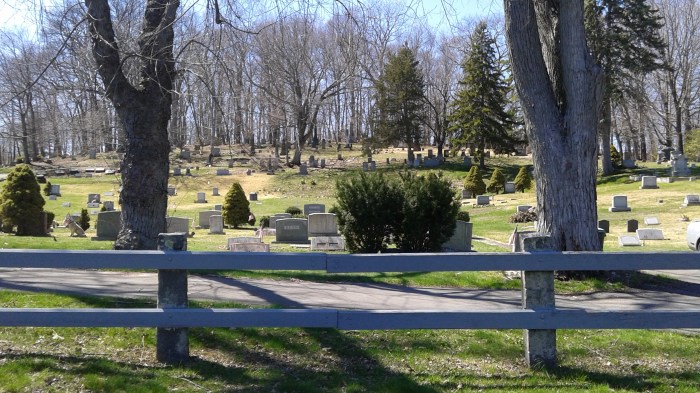
West Lane Cemetery in Kensington isn’t actually on West Lane, it’s on High Road. It’s situated on the side of a hill and has only a narrow paved path to get to the top. The path isn’t really wide enough for a hearse. In March, 1990 my grandmother was buried there, and me, my brother and cousins, who were pallbearers, had to carry her casket up the relatively steep hill, almost to the top. This was twenty years before I started doing genealogy, and I had no idea at the time how important this cemetery is to my family history or how many relatives we were walking over as we made our way up the hill to my grandmother’s final resting place next to my maternal grandfather.
The Moore’s that my mother knew were in Southington on Andrews Street. These were her father’s maternal uncles, aunts and cousins and they visited them often when my mother was growing up. So in 2010, I was perplexed as to why my grandparents were buried in Kensington. They’re buried in a plot with my grandfather’s parents (my great grandparents), Charles and Sara (Moore) Kellogg. On a visit to West Lane with my mother that year I asked her why they were buried in Kensington and not Southington. Mom, who has a habit of answering questions she doesn’t know the answers to with simple responses, looked down the hill and scanned the landscape and replied, “I think they really liked the view”. It made sense, it really is beautiful there.
However, there was more to the story. Sara Moore was the daughter of Charles and Sarah (Horton) Moore who are also buried in West Lane. Charles Moore owned a farm and at least two houses on Andrews Street in Southington and died there in 1913. So it still didn’t make any sense why he was buried in Kensington. More research revealed that Charles was the son of Sheldon and Susan (Dickinson) Moore and he was born in Kensington in 1834 and lived there until he married in 1857. Mystery solved.
But going back another generation to Sheldon’s parents, Roswell and Lovina (Phillips) Moore, I found Roswell lived on Andrews Street in Southington, a mile north of what was later Charlie Moore’s home and farm.
Roswell and Lovina Moore are buried in Oak Hill Cemetery in Southington along with Roswell’s parents, Roswell and Desire (Dunham) Moore. Also buried there are Roswell and Lovina’s sons, Eli, Nelson, Charles and Lurian, and their daughters, Mrs. Dimmis Grannis and Mrs. Sarah Frisbie. Nelson and Lurian being the only two of Roswell’s twelve children not to survive to adulthood.
Roswell Moore owned R. Moore and Sons or Moore’s Millsin Kensington. Sons, John, Roswell, Jr., and Oliver were sent there to work the mills. John later removed to West Springfield, Massachusetts and is buried in Agawam Center Cemetery in Agawam. Roswell, Jr., Oliver, and later Sheldon all made Kensington their home and all three died there and are buried in West Lane Cemetery.
The first Moore buried in West Lane was Caroline (Leonard) Moore, the first wife of Oliver, who died in 1829. According to findagrave.com there are 48 Moore’s buried in West Lane, all of them related. The one exception being Pauline (Moore) Canfield who was the daughter of Walter and Adeline (Castle) Moore. Walter Moore was in no way related to these Moore’s, but when Adeline divorced him and married Roswell Allen Moore, Jr. (great grandson of Roswell Moore) sometime after 1900, Pauline Moore became Roswell Allen Moore’s stepdaughter, thus connecting her to these Moore’s. There are still others in West Lane who are also related to this line of Moore’s but don’t go by the name Moore, including my grandfather.
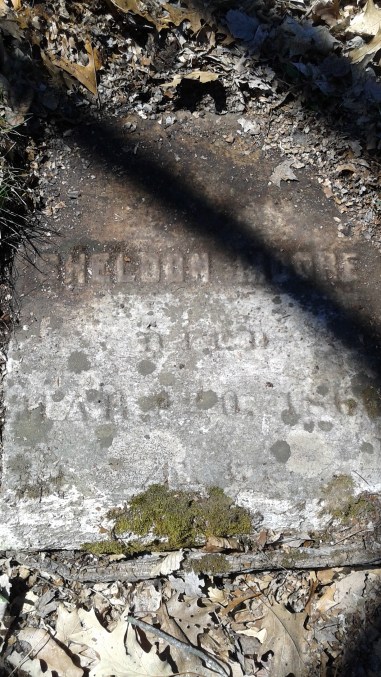
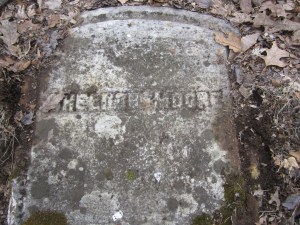
Sheldon Moore is buried next to his wife adjacent to the paved path near the top of the hill. His headstone fell over before 2010 and the soft earth at West Lane is slowly claiming it. I’ve visited the cemetery at least once a year for the past six years. When I do, I make sure to brush the leaves, dirt and grass off his stone, revealing his name and epitaph so that his final resting place will not be lost just yet.
Sheldon Moore, died Mar. 20, 1866, age 67 yrs.
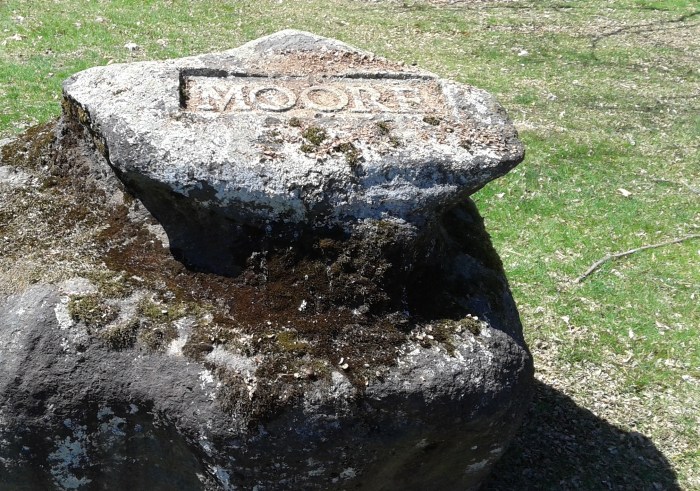
There’s a boulder in West Lane that, according to Ethelbert Allen Moore, was once in the middle of Sheldon Moore’s apple orchard. Carved into the top of it is the name, Moore. I once wondered why West Lane wasn’t called High Road Cemetery. I’m beginning to wonder why it’s not called Moore Cemetery.
Sources:
findagrave.com
ancestry.com
Hale Collection of Cemetery Inscriptions and Newspaper Notices, 1629-1934
Tenth Generation by Ethelbert Allen Moore (1950)
I’m a descendant of the following people buried at West Lane Cemetery:
Welcome to my blog about my great-great-great grandfather, Sheldon Moore. I’m an amateur genealogist and wannabe historian and I’ve been building my family tree on ancestry.com since March 2010. I have become fascinated with the Moore branch of my family and have devoted an enormous amount of time researching Sheldon Moore and his wife, children, siblings, in-laws, nieces, nephews, neighbors, friends and acquaintances. Not to mention his hometown of Southington, Connecticut and his home of over 30 years in the Kensington section of Berlin, Connecticut.
I’ve been amazed at how much information I’ve been able to find on this one man. I’ve discovered a paper trail of documents and personal letters in the library at
Sheldon Moore’s headstone in West Lane Cemetery, Kensington, CT
Yale University (his Alma Mater), the Connecticut Historical Society and the University of Michigan. His name appears in books, newspaper articles and other periodicals on subjects concerning cement manufacturing, horticulture, sundial manufacturing and teaching, just to name a few.
So, 150 years and 7 days following his death I dedicate this blog to telling the story of Sheldon Moore’s life, his accomplishments, his failures, his relationships with his family and friends, and his legacy.












 Sheldon Moore