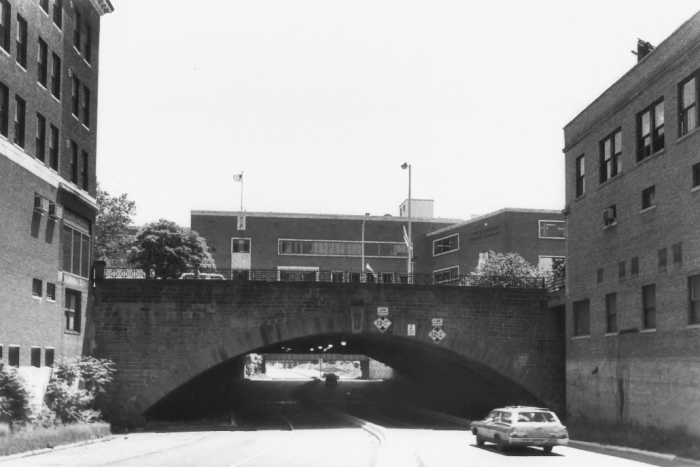
Anyone taking the Capitol Avenue exit from Interstate 91 (Exit 29A) in Hartford, Connecticut will find themselves on the Whitehead Highway. After passing under the Hartford Public Library, but before reaching Pulaski Circle, they will pass under a very old stone bridge. The bridge was built in 1833 and is listed on the National Register of Historic Places. The structure was the largest single arch bridge in the United States at the time it was constructed along Main Street, and it spanned the Park River (or Mill River, as it was known then).
On the last page of Frank D. Andrews’ book, History of the Discovery of Water-Limestone and Early Manufacture of Cement at Southington, Connecticut, Andrews says that the mortar used on the Main Street Bridge over the Park River was “Andrews cement” that was manufactured in Southington. He cites George W. Bartholomew as his source. The actual name of the company was L & G Andrews. The “L” being Luman and the “G” being Gad, father and son respectively.
Originally, the citizens of Hartford were wary of the new bridge and would tie their horses and walk over the bridge out of fear of collapse. But the bridge, which has been in constant use since, has withstood the test of time and the floods that plagued the Park River.

It’s even outlived the river that it once spanned. In 1940, the city of Hartford started planning the Park River conduit project, which essentially buried the river so that a highway could be built over it. Three of the four bridges over the river were scheduled to be reconstructed. The only surviving bridge was the stone bridge on Main Street. The project began in 1941 and was completed around 1943. An article that appeared in the Hartford Courant in 1942 described proponents and opponents of the project, lining the Main Street Bridge and watching steam shovels struggle mightily to remove heavy shale rock that lined the river bed.
When it was built 185 years ago, the Springfield Republican called the new stone bridge, “an imposing piece of masonry, which will endure for ages”. They were absolutely right. And it’s all held together by cement that was produced in Southington by L & G Andrews.
Sources:
Memorial History of Hartford County, Connecticut 1633-1884 (1886), Chapter 2, Section 1, “The Town Since 1784” by Miss Mary K. Talcott, page 369.
History of the Discovery of Water-Limestone and Early Manufacture of Cement at Southington, Connecticut by Frank D. Andrews (1924).
Various newspaper articles from the Hartford Courant found on newspapers.com.
______________________________________________

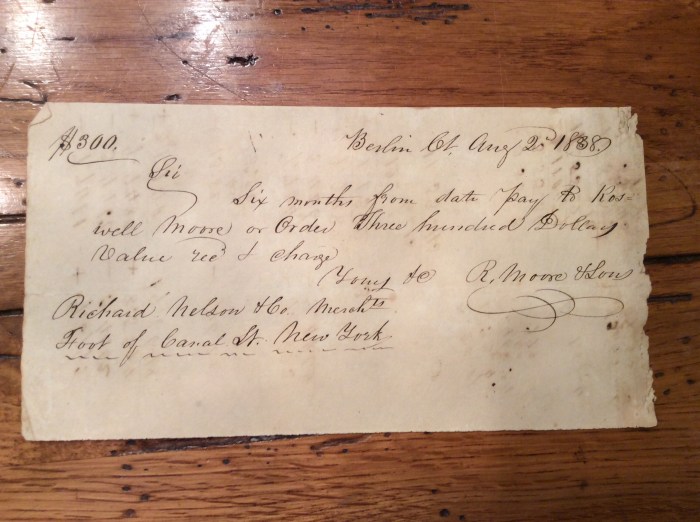
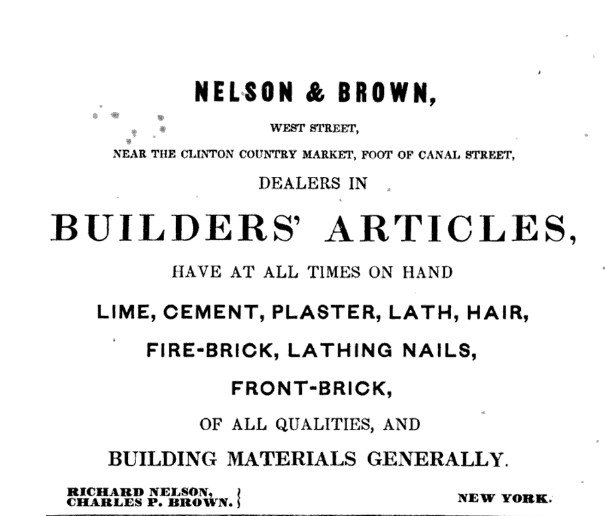
In 2017, a Hutton’s Mathematics Math Book came into my possession. The book had once belonged to Sheldon Moore, and he had bought it in 1816 when he was attending Yale College. Inside the book were a few pieces of paper that had been written on by Sheldon, including a bill for cement from R. Moore & Sons to Richard Nelson of New York City. Richard Nelson was the co-owner of Nelson & Brown and a supplier of cement.
Please read my blog Set in Cement
 Sheldon Moore
One thought on “Addendum to “Set in Cement””