
Recently I was lucky enough to purchase a sundial that was manufactured by Sheldon Moore around 1840. The cast iron sundial is almost 10 inches in diameter and the gnomon stands nearly 5 inches high. It will keep perfect time from as far north as Montpelier, Vermont and as far south as Washington D.C.
I found it online at Delaney Antique Clocks (delaneyantiqueclocks.com) which is located in West Townsend, Massachusetts. One of the store’s owners, John Delaney has been featured many times on PBS’s Antique Road Show. Imagine my surprise when I googled “sundial manufactured by S. Moore Kensington, CT”, and as it turned out there was one for sale. I quickly emailed John Delaney and asked for a price. He replied that it was $150. I considered haggling with him but thought better of it and paid the full asking price plus shipping. Did I pay too much? Maybe, but this was a rare opportunity to have a treasured family artifact. Truth is I probably would have paid more.

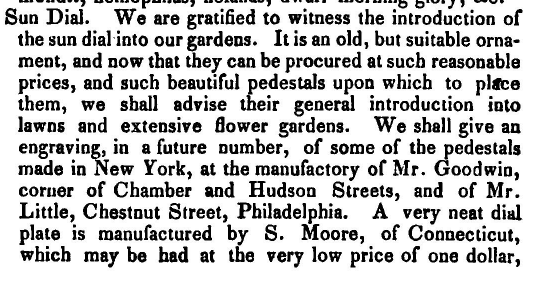
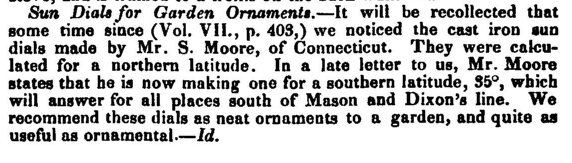
This is not the first time I’ve seen a Sheldon Moore sundial. In October, 2014 I was able to see one at the Connecticut Historical Society in Hartford. That sundial, which is blueish in color and not pictured here, was donated to the Historical Society by the Moore family in 1947 (I’m not sure by which Moore’s). An article published in the Connecticut Historical Society Bulletin in October, 1947 describes Sheldon Moore’s sundial business, which is believed to have existed between 1840 to 1841 and was abandoned due to a small profit margin. I did however, find an article published in the New Genesee Farmer dated June, 1842. The 1947 Bulletin article was reprinted in December, 2008 in The Compendium, a quarterly journal published by the North American Sundial Society. The article goes into great detail about the cost of manufacturing the sundials, and in a nutshell, it cost .50 cents to make one and each sold for a dollar. Now, given inflation over the last 170 years, I think I got a pretty good deal.
If you would like to read The Compendium article, it can be found online at http://sundials.org/index.php/dial-resources.
________________________


Last summer I bought a first edition Poems by James G. Percival, which I found online on eBay. I think I paid $50 for it. Since discovering that Sheldon Moore was a close, lifelong friend of Percival I’ve become somewhat fascinated by this strange, eccentric man. I’ve done a lot of research on him and even read some of his poetry. I’ve never been much of a poetry reader so I have nothing to compare it to, but I really like his writings. My favorites are Prometheus I and II and The Dream of a Day. Percival was very popular in his day but his work hasn’t stood the test of time and today his books are hard to find. That being said, the book I bought is in rough shape and the back cover is literally hanging by a string, and it probably isn’t worth the $50 I paid for it. But, as I discovered, this little book had it’s own story to tell.
Written on the first page is, “John G. Locke 1826”. In the back of the book this same John G. Locke wrote, “May 25th 1826. Heading for the Mona Passage on the James Coulter -J.G.L.” Some research by yours truly turned up some interesting information.

John Goodwin Locke was born in Ashby, Massachusetts on April 1, 1803 and died in Boston on July 22, 1869. On October 25, 1829 he married Jane Ermina Starkweather of Worthington, Massachusetts. Mrs. Locke was a poet herself and her most popular work was Boston: A Poem published in 1842. In later years, John G. Locke was a lawyer but early on he was in the mercantile business and in 1826 he went to Caracas, Venezuela as an agent for a New York commercial house. It’s said that he returned the same year because business was unprofitable. But his return may have had more to do with regional uprisings throughout Venezuela. Newspaper articles from the time reported that the brig James Coulter had arrived in New York on May 28, 1826 and had brought news from Venezuela about the revolution brewing in that country. John G. Locke appears with five other merchants on the James Coulter’s manifest when it arrived in Falmouth, Massachusetts from Venezuela in June, 1826.

But what I personally found most fascinating about John G. Locke was that he was a genealogist. In 1853 he published two books, The Book of Lockes and The Munroe Genealogy. He was also a member of the New England Historical Society.
In the beginning of Percival’s book of poems he quoted Robert Southey, “Go little book, from this my solitude, I cast thee on the waters-go thy ways. And if, as I believe, thy vein be good, the world will find thee after certain days”. I know my little book traveled on the waters, in late May, 1826. It left Venezuela and sailed the strait between Hispaniola and Puerto Rico known as the Mona Passage on the James Coulter on route to New York and ultimately Falmouth. In 2015 it somehow found it’s way to me in Connecticut, and just days after receiving it I brought it with me to Kensington when I photographed Percival’s home where much of the book was written in 1820. Thus completing the little book’s journey.
Sources:
- ancestry.com
- wikipedia.org
- The New England Historical and Genealogical Register and Antiquarian Journal, Vol. 25, pg. 92 (1871)
 Sheldon Moore