
In 1925, 21 year old Idabelle Lindsley of Kensington photographed a sign near Steel Shop Pond on the Mattabassett River that read, “CEMENT MILL, Site of first cement mill in United States, 1829”. This is a rather bold and entirely untrue statement. The sign should have read, “Site of the first blue limestone, hydraulic cement mill in Connecticut, 1826”. Though even this statement is debatable.
Fact: A cement mill owned by Roswell Moore of Southington and operated by his sons, Roswell, Jr. and Oliver did exist in Kensington from at least 1826 until the 1850’s under the name R. Moore & Sons.
Fact: Hydraulic or water cement was being manufactured in New York near the Erie Canal as early as 1818.
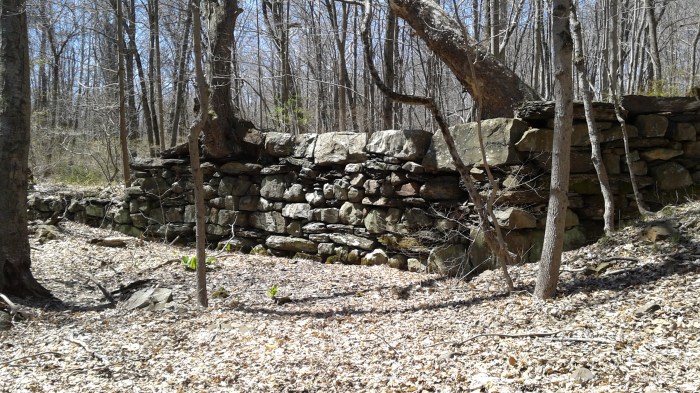
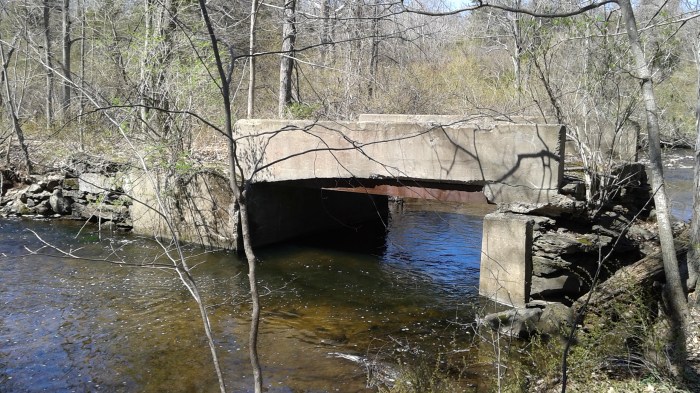
In 1801, Roswell Moore had bought Solomon Winchell’s half of a grist and carding mill that Winchell co-owned with Dr. James Percival (father of poet James G.), and by 1817, Roswell owned the mill entirely, following the sudden death of Dr. Percival. This mill, between High Road and Glen Street, just west of the Congregational Church, was also used in the production of linseed oil. Later a saw mill was added. Just to the south another mill was built for manufacturing kiln dried meal, and it was this mill that was eventually converted into the cement mill. These mills collectively were known as “Moore’s Mills”.
But the story of the cement mill begins in Southington with Sheldon Moore and his friends, Gad Andrews (son of Luman Andrews) and Anson Merriman.
The Luman Andrews homestead and farm was at the corner of what is now Andrews and Woodruff Streets, not far from the Berlin line. Almost a mile north was Roswell Moore’s property and between them was Anson Merriman’s home.
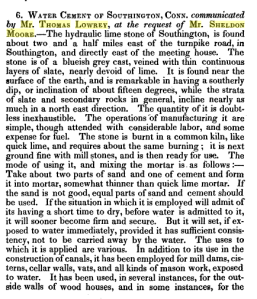
Sheldon Moore had graduated from Yale in 1818 with a law degree and had worked as a teacher in Vansville, Maryland and Sharon, Connecticut. He shared a mutual interest in science with his friends Andrews and Merriman and subscribed to the American Journal of Science and the Arts, which was published by his old college professor, Benjamin Silliman. In 1825, the three men had read an article in the journal about limestone being used to make cement for the Erie Canal. In the early 1800’s the young country was very much in need of a water limestone or hydraulic cement that would harden in water to be used to construct canals, dams and bridges. Merriman remembered seeing an outcrop of a blue limestone on the Andrews property and wondered if it might be used to make cement.
Sheldon then wrote Professor Silliman asking him if this blue limestone might have the necessary properties to make hydraulic cement, when Silliman didn’t respond immediately, an anxious Anson Merriman wrote several more letters. Professor Silliman’s response to Sheldon was simple, an experiment was needed using the blue limestone. The rock would need to be burnt, then pulverized, mixed with sand and left in water to see if it would set. The experiment was a success and plans were made to begin manufacturing.

But soon after the blue limestone was also discovered on the Moore property. It is here that the Moore and Andrews firms appear to have parted ways. Roswell Moore seems to have been a shrewd businessman. So why would he want to share the profits of this new enterprise with Luman Andrews? After all, he possessed his own supply of blue limestone, and the kilns that were needed to burn it were already being constructed just south of the Moore home. Plus, he had something that Andrews didn’t; a working mill that would be needed to grind the limestone.
Not only did Luman Andrews not have a mill, he didn’t even possess the water power necessary to power one. This was remedied in July of 1829 when they leased and later purchased land from Seth Cowles of Berlin, on what is now Carey Street in Southington, where they constructed a dam and mill.
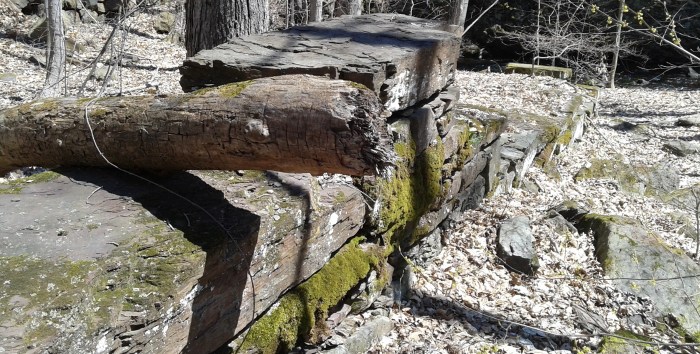
The Moore’s also had all the key people needed to run a successful cement business. Younger brother Eli Moore handled things on the Southington side, which included quarrying the blue limestone and burning it in the kilns. The quarry being located across the road from the Moore homestead where the Wassel Reservoir is now. The limestone was then transported 3 1/2 miles away, via Carey Street between the two Hart ponds, to the mill in Kensington. Here, Roswell, Jr., an expert miller, ground the limestone. It was then put into barrels and brought to Middletown where it was shipped to agents and suppliers who sold it to customers as far away as the West Indies. Oliver Moore, the engineer of the family, was in charge of building dams, mills, and probably the kilns. Sheldon Moore acted as comptroller, accountant and handled legal affairs. And Roswell Moore was the owner and CEO, who not only used his business skills to find suppliers and customers, but also handled advertising.

On a personal level, this venture was exactly what Sheldon needed to redeem himself with his father. Roswell Moore, who had paid Sheldon’s tuition at Yale, had viewed his son’s education as a kind of investment. An investment that up to this point, that had not paid off. The cement business became R. Moore & Sons most profitable enterprises.
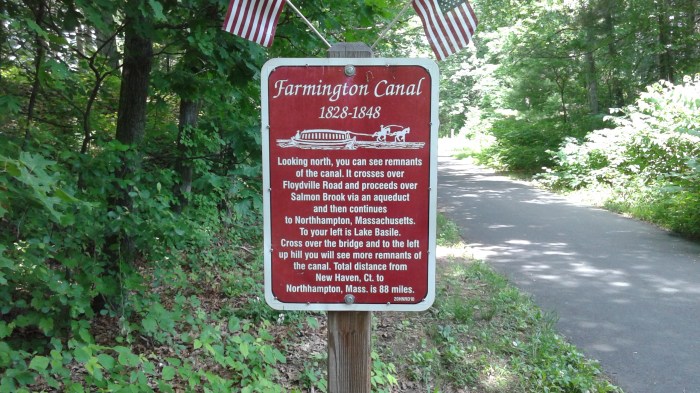
One of the first customers, of what was still Moore & Andrews, was the Farmington Canal Company. The Farmington Canal operated from 1828-1848 and ran from Northampton, Massachusetts to New Haven, Connecticut. Cement from Southington was used to build bridges, locks, piers, abutments and culverts and a stone dam that crossed the Farmington River. Farmington Canal Company began purchasing cement from Moore & Andrews as early as 1826. The canal became obsolete with the coming of the railroad, which in many sections, ran adjacent to the canal. Today the railroad is also gone and has been replaced by the Farmington Rail Trail, a bike path.
By 1828, there was another competitor from Southington in the cement business, the firm of Barnes & Bradley which was operated by Liva Barnes and Jason Bradley. Their quarry was located south of the Andrews homestead and they built their mill on the property of David Sloper. The new competition drove the price of cement down, but in spite of this, the Moore’s cement business continued to turn a profit for the next three decades.
However, what was once considered an inexhaustible supply of blue limestone in Southington was beginning to dwindle by the early 1850’s. Barnes & Bradley had already run out and the Moore and Andrews firms were running low. Roswell Moore and Luman Andrews were now dead and what was left of the cement businesses was being run by Eli Moore and Bennett J. Andrews (son of Luman), who resurrected the original firm of Moore & Andrews.
By the late 1850’s the manufacturing of cement by Moore & Andrews had ceased completely. A few years prior, Roswell, Jr. retired from milling and became deacon of the Congregational Church in Kensington. Oliver Moore converted the cement mill into a shop that manufactured steelyards and gardening tools. And Gad Andrews had also retired, turning his attention to genealogy.
The next generation of Moore’s and Andrews’ both tried to take credit for being the first to manufacture hydraulic cement. In his unpublished autobiography, Nelson Augustus Moore (son of Roswell, Jr.) claimed that R. Moore & Sons had been the first to successfully market hydraulic cement and that Anson Merriman’s attempts to market the cement had failed. In his book, Ecclesiastical and Other Sketches of Southington, Connecticut published in 1875, Heman R. Timlow also claimed that Gad Andrews and Merriman’s cement business had actually failed. Although Anson Merrimans role in the cement industry is unknown it’s certainly not true that the Andrews firm had failed.
In 1924, Frank D. Andrews (son of Bennett J.) wrote a privately published and incredibly informative book called, History of the Discovery of Water-Limestone and Early Manufacture of Cement at Southington, Connecticut in which he doesn’t claim, but certainly implies that the Andrews family were the first in the State to manufacture cement.
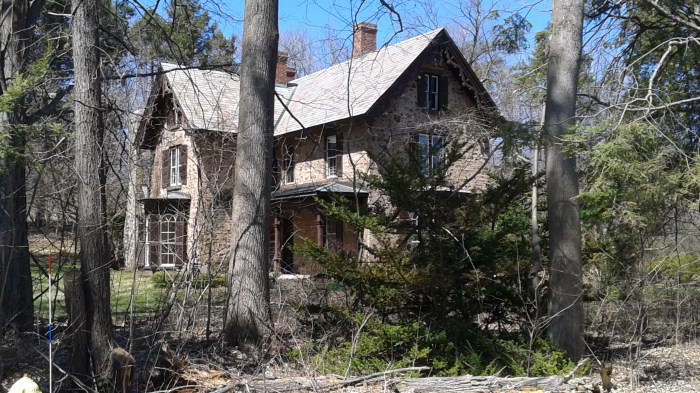
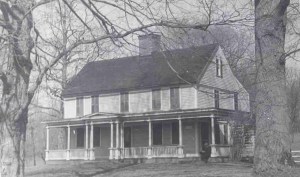
In his aforementioned autobiography, N. A. Moore vividly describes the mills in Kensington, including the trees and foliage surrounding the streams and ponds near the mills and the day to day operation of the mills. Moore also sketched and painted several pictures of the mills in Kensington. Around 1865, he briefly reopened the cement mill in order to produce enough cement to build his house on High Road, next door to his father’s home, that he called “Stonehouse”.
Sources:
Early Cement Manufacture in Connecticut by Clarence N. Wiley, presented at the 49th Annual Meeting of the Connecticut Society of Civil Engineers, Hartford, Connecticut, Feb. 22, 1933
History of New Britain with Sketches of Farmington and Berlin by David N. Camp (1889)
History of the Discovery of Water-Limestone and Early Manufacture of Cement at Southington, Connecticut by Frank D. Andrews (1924)
Autobiography of Nelson Augustus Moore of Kensington, Connecticut
Sheldon Moore Papers Yale University Manuscript (MS 992)
Connecticut Mill Sign, Berlin photographed by Idabelle Lindsley Tatro (1925) Connecticut Historical Society Object Number 1977.92.297
For more information please read Addendum to “Set in Cement”



 Sheldon Moore